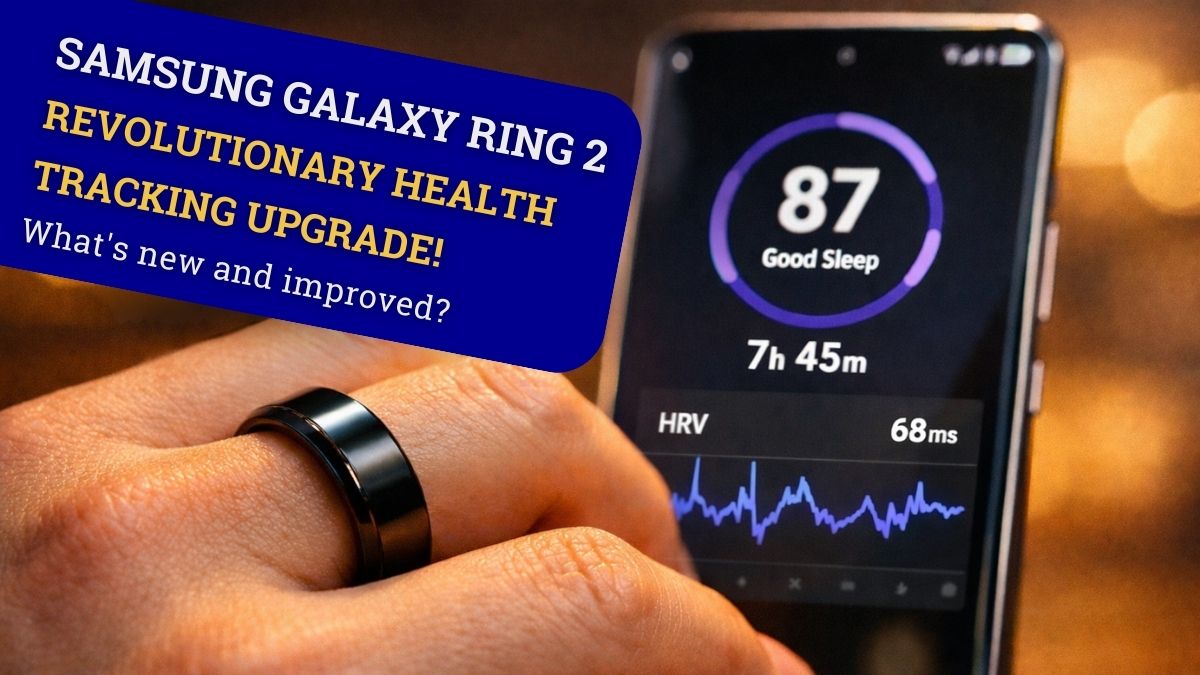

It’s March 2026, and Samsung’s wearable strategy is getting more ambitious: the Samsung Galaxy Ring 2 health tracking upgrade is shaping up as the kind of quiet change that can make smart rings feel less like a novelty and more like the default. The promise isn’t just “more sensors.” It’s better signal quality, smarter insights, and fewer reasons to fall back to a smartwatch.
The surprising part: the next leap in ring-based health tracking may not be a brand-new metric at all—it may be accuracy. When a ring nails consistency (especially at night), it can beat wrist wearables at the one job most people actually care about: turning daily habits into usable feedback.
- Why the Samsung Galaxy Ring 2 health tracking upgrade matters
- What’s new: the health tracking upgrades to watch for
- Galaxy Ring 2 vs Galaxy Ring: what might change
- Real-world impact: who actually feels the upgrade?
- Pros and cons (based on what matters in daily use)
- USA pricing (what to expect in dollars)
- Who should buy Galaxy Ring 2 (and who shouldn’t)
- Should you wait for Galaxy Ring 2?
- Final verdict
- FAQs
- 1. What’s new in the Samsung Galaxy Ring 2 health tracking upgrade?
- 2. Does the Samsung Galaxy Ring 2 health tracking upgrade track steps?
- 3. Can the Samsung Galaxy Ring 2 health tracking upgrade monitor heart rate 24/7?
- 4. Is the Samsung Galaxy Ring 2 health tracking upgrade good for sleep analysis?
- 5. Does the Samsung Galaxy Ring 2 health tracking upgrade measure body temperature?
- 6. Can multiple users share one Samsung Galaxy Ring 2 health tracking upgrade?
- 7. How long does the Samsung Galaxy Ring 2 health tracking upgrade battery last?
- 8. Is the Samsung Galaxy Ring 2 health tracking upgrade waterproof?
- 9. Can the Samsung Galaxy Ring 2 health tracking upgrade replace fitness trackers?
- 10. How soon will the Samsung Galaxy Ring 2 health tracking upgrade be available?
Why the Samsung Galaxy Ring 2 health tracking upgrade matters
Most wearables fail the same way: they collect data, then dump it on you. The real win is when a device makes health tracking passive, reliable, and easy to act on—without nagging or requiring you to charge another screen.
Smart rings have a built-in advantage for sleep and recovery. They’re lighter, less intrusive, and typically maintain steadier skin contact at night. If Samsung leans into that and tightens its measurement accuracy, the Galaxy Ring 2 could become the “always on” tracker that feeds your broader ecosystem, including Galaxy phones and watches.
Samsung also has an ecosystem angle other ring makers can’t touch. If you already live in the Galaxy world, this upgrade could slot neatly alongside your phone and buds—similar to how Apple Watch plays quarterback for iPhone users. (If you’re also shopping the watch side, our guide to Samsung Galaxy Watch features and pricing may help you decide what belongs on your wrist vs. your finger.)
What’s new: the health tracking upgrades to watch for
Samsung hasn’t published a final spec sheet as of this writing, but the most credible “Ring 2” talk across the wearable supply chain and Samsung’s typical iteration pattern points to upgrades in three buckets: better sensing, better modeling, and better battery management.
1) Cleaner heart-rate and HRV readings (especially during sleep)
For rings, heart-rate and HRV (heart rate variability) are the backbone metrics. The upgrade we’re watching for is improved optical signal capture—think stronger LEDs, refined photodiode placement, and better motion filtering.
- More stable HRV trends (less random noise from position changes at night)
- Fewer “gaps” in sleep charts when you roll over or your hand is under a pillow
- Better workout detection for light cardio and walks without needing a watch
2) More useful sleep coaching, not just sleep scores
Sleep scores are fine; behavior change is harder. Samsung’s likely next move is translating multi-night patterns into simple coaching that isn’t patronizing—like flagging late caffeine impact or inconsistent bedtimes with realistic suggestions.
If you’ve ever compared trackers, you’ve seen how different the results can look. Samsung’s opportunity is to tighten correlations between sleep staging, overnight movement, and next-day readiness. If you’re curious how Samsung stacks up in the broader wearable space, our breakdown of Apple Watch vs Galaxy Watch highlights how much software interpretation matters.
3) Skin temperature trends with fewer false alarms
Temperature sensing is most valuable when it’s subtle: trends over time that can hint at illness, recovery load, or cycle tracking (where supported). The big challenge is avoiding random spikes from environment changes.
A Galaxy Ring 2 upgrade could focus on improving baseline detection and smoothing—so a warm bedroom doesn’t trigger a “you might be sick” warning. That’s the kind of behind-the-scenes improvement that makes a wearable feel trustworthy.
4) Better auto-detection and tagging of daily activity
Rings aren’t ideal for high-intensity workouts, but they can be excellent for passive activity tracking if the algorithms are sharp. Look for improved walking detection and smarter “effort” estimates using combined heart rate, motion, and recovery signals.
One practical improvement would be better integration with Samsung Health’s trend views—so you can see which behaviors move the needle week-to-week, not just day-to-day. If you’re already tuning your ecosystem, this is also where phone performance and battery matter; our piece on Samsung Galaxy battery life expectations pairs well with an always-on tracker.
5) Battery and charging that fits real life
Battery life is the quiet dealbreaker. If Galaxy Ring 2 can stretch meaningfully longer between charges—or charge faster in short bursts—it becomes easier to wear 24/7, which is the only way health tracking gets truly useful.
- Longer standby and fewer “low battery” interruptions
- Smarter power scaling (high sampling at night, lower during sedentary work)
- More accurate battery estimation so you’re not surprised mid-trip
Galaxy Ring 2 vs Galaxy Ring: what might change
Because Samsung’s ring concept is still new compared to its watch line, a second generation is likely to focus on refinement. Here’s a realistic comparison of what we expect to matter most for buyers deciding whether to upgrade.
| Category | Galaxy Ring (Gen 1) | Galaxy Ring 2 (Expected) |
|---|---|---|
| Sleep tracking | Strong comfort, solid estimates | Better accuracy and fewer gaps from improved signal processing |
| HR/HRV reliability | Good baseline, varies by fit | More consistent readings across nightly movement and daily activity |
| Temperature trends | Useful but context-sensitive | Fewer false spikes, smarter baselines |
| Battery experience | Competitive, depends on usage | Longer real-world life and/or faster top-ups |
| Insights | Core metrics, improving software | More actionable coaching tied to habits and trends |
Real-world impact: who actually feels the upgrade?
The best wearables don’t change your life on day one; they change it on day thirty. If Samsung nails the Galaxy Ring 2 health tracking upgrade, these are the people who will notice first.
- Sleep-first users who hate wearing a watch overnight but want dependable sleep and recovery insights
- Busy professionals who prefer passive tracking over manual workout logging
- Fitness “maintainers” (walks, light cardio, strength) who want trends more than athlete-grade stats
- Galaxy ecosystem users who want their health data synced cleanly across Samsung Health
There’s also a sneaky benefit: rings can reduce “screen wearables fatigue.” People who get tired of constant wrist notifications often quit tracking altogether. A ring stays out of the way.
Pros and cons (based on what matters in daily use)
Pros
- More comfortable 24/7 tracking than most watches, especially for sleep
- Potential accuracy jump if Samsung improves signal quality and modeling
- Better ecosystem leverage with Galaxy phones and Samsung Health insights
- Lower friction: you can track without wearing another screen
Cons
- Fit is everything—ring sizing and finger choice can make or break accuracy
- Workout limitations for intense training compared to chest straps or watches
- Smart features are limited (no big display, fewer interaction options)
- Pricing pressure: rings need to justify cost against discounted smartwatches
USA pricing (what to expect in dollars)
Samsung hasn’t confirmed official U.S. pricing for a “Galaxy Ring 2” yet. If it follows typical second-gen strategy, expect it to land in a familiar premium smart ring band—likely $299 to $399 depending on finish and any bundle promos.
A key factor is whether Samsung keeps the experience free inside Samsung Health or pushes premium analytics. If a subscription shows up, that changes the math quickly. Buyers are increasingly sensitive to “device + subscription” stacks, especially when a watch can do many of the same things.
Who should buy Galaxy Ring 2 (and who shouldn’t)
Buy it if you want sleep and recovery tracking you’ll actually wear every night, and you’re already invested in Samsung Health. This is especially true if you dislike sleeping with a watch or you rotate watches and want one consistent tracker.
Skip it if your top priority is training metrics for hard workouts, GPS runs, or on-device coaching. A watch (or dedicated fitness gear) is still the better tool for that job. If you’re debating where to put your money, it’s worth reading our guide on the best smartwatches to buy to see whether a wrist device covers your needs.
Should you wait for Galaxy Ring 2?
If you’re coming from no wearable at all, waiting can be smart—mainly because second-gen products tend to fix the small annoyances that don’t show up in marketing. Better signal stability, fewer weird sleep gaps, more consistent HRV trends: those are “quality of life” upgrades you notice every day.
If you already own the first Galaxy Ring and it fits well, I’d wait for confirmed details before upgrading. The only reason to jump early would be if Samsung promises a clear improvement in accuracy or battery life, not just new dashboards.
My prediction: Samsung will push Ring 2 as the “silent partner” to Galaxy Watch—letting the ring handle overnight and all-day baselines while the watch handles workouts and notifications. That division of labor actually makes sense.
Final verdict
If Samsung delivers what the Samsung Galaxy Ring 2 health tracking upgrade hints at—cleaner HRV, steadier sleep data, smarter temperature baselines, and battery improvements—this could be the ring that pushes health tracking into the background where it belongs. For most people, the best wearable is the one you forget you’re wearing, and Ring 2 has a real shot at becoming that.
Click to Find More: Apple iPhone Foldable India Launch 2026: Game-Changing Price, Release Date & What Buyers Can Expect
FAQs
1. What’s new in the Samsung Galaxy Ring 2 health tracking upgrade?
The Samsung Galaxy Ring 2 health tracking upgrade brings better sensors and smarter health insights.
2. Does the Samsung Galaxy Ring 2 health tracking upgrade track steps?
Yes, the Samsung Galaxy Ring 2 health tracking upgrade can track daily steps and activity automatically.
3. Can the Samsung Galaxy Ring 2 health tracking upgrade monitor heart rate 24/7?
Yes, continuous heart rate tracking is part of the Samsung Galaxy Ring 2 health tracking upgrade.
4. Is the Samsung Galaxy Ring 2 health tracking upgrade good for sleep analysis?
The Samsung Galaxy Ring 2 health tracking upgrade improves sleep tracking with better accuracy.
5. Does the Samsung Galaxy Ring 2 health tracking upgrade measure body temperature?
Yes, body temperature trends are included in the Samsung Galaxy Ring 2 health tracking upgrade.
6. Can multiple users share one Samsung Galaxy Ring 2 health tracking upgrade?
Each user needs their own, as the Samsung Galaxy Ring 2 health tracking upgrade is personalized.
7. How long does the Samsung Galaxy Ring 2 health tracking upgrade battery last?
Battery lasts several days even with full use of the Samsung Galaxy Ring 2 health tracking upgrade.
8. Is the Samsung Galaxy Ring 2 health tracking upgrade waterproof?
Yes, basic water resistance is part of the Samsung Galaxy Ring 2 health tracking upgrade.
9. Can the Samsung Galaxy Ring 2 health tracking upgrade replace fitness trackers?
For basic wellness, the Samsung Galaxy Ring 2 health tracking upgrade works well, but smartwatches still offer more features.
10. How soon will the Samsung Galaxy Ring 2 health tracking upgrade be available?
Release dates may vary, but the Samsung Galaxy Ring 2 health tracking upgrade is expected in 2026.