
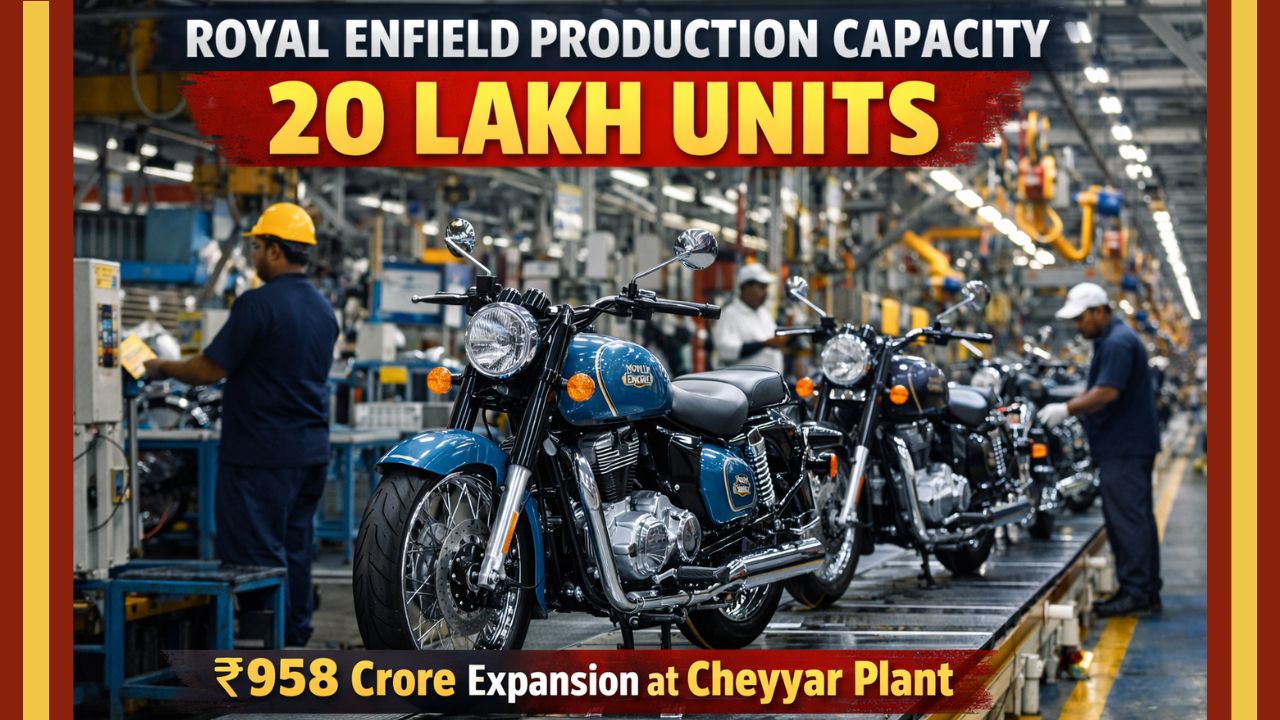

- Royal Enfield production capacity is entering a transformative phase as Eicher Motors approves a ₹958 crore investment to scale annual output to 20 lakh units.
- Why Royal Enfield Production Capacity Needed Expansion
- Investment Overview
- The Cheyyar Plant: The Growth Engine
- Sales Growth Driving Capacity Expansion
- Strategic Objectives Behind Increasing Royal Enfield Production Capacity
- Competitive Landscape: Why Timing Matters
- Customer Impact: What Buyers Can Expect
- Economic & Industrial Impact
- Quality Assurance During Expansion
- Royal Enfield’s Mid-Size Dominance
- Financial Confidence from Eicher Motors
- Potential Risks
- The Bigger Picture: Preparing for the Next Decade
- Conclusion
Royal Enfield production capacity is entering a transformative phase as Eicher Motors approves a ₹958 crore investment to scale annual output to 20 lakh units.
The expansion, centered primarily around the Cheyyar manufacturing facility in Tamil Nadu, marks one of the most significant industrial upgrades in Royal Enfield’s modern era. With demand accelerating across India, Europe, Latin America, and Southeast Asia, this strategic move aims to reduce waiting periods, strengthen exports, improve operational efficiency, and reinforce Royal Enfield’s leadership in the global mid-size motorcycle segment.
This is not merely a factory upgrade. It is a long-term strategic play that signals confidence, scale, and global ambition.
Why Royal Enfield Production Capacity Needed Expansion
Royal Enfield has witnessed sustained demand growth over the past several financial years. The brand’s revival story — from a struggling legacy manufacturer to a dominant mid-size motorcycle leader — has been driven by:
Modern 350cc J-platform success
Himalayan 450 global traction
650cc twin-cylinder lineup expansion
Aggressive export strategy
Lifestyle positioning and community culture
Waiting periods for popular models such as the Classic 350, Hunter 350, and Super Meteor 650 have periodically extended beyond comfortable timelines in several regions. Increasing Royal Enfield production capacity ensures supply catches up with demand.
Investment Overview
| Category | Details |
|---|---|
| Investment Amount | ₹958 Crore |
| Parent Company | Eicher Motors |
| Current Annual Capacity | 14.6 Lakh Units |
| Target Annual Capacity | 20 Lakh Units |
| Capacity Increase | Approx. 37% |
| Primary Location | Cheyyar Plant, Tamil Nadu |
| Completion Timeline | By FY2027–28 |
This 37% jump in Royal Enfield production capacity is among the largest capacity expansions in the brand’s recent history.
The Cheyyar Plant: The Growth Engine
The Cheyyar facility in Tamil Nadu will anchor the production increase. This plant already plays a critical role in Royal Enfield’s manufacturing ecosystem.
Planned Enhancements Include:
New assembly lines
Advanced robotic automation
Digitized quality inspection systems
Expanded paint shop capacity
Supply chain digitization
Higher localization efficiency
The company has emphasized that increased Royal Enfield production capacity will not compromise quality — a core pillar of the brand’s revival.
Sales Growth Driving Capacity Expansion
Royal Enfield’s growth trajectory provides clear justification for scaling up.
| Financial Year | Approximate Sales (Units) | Growth Trend |
|---|---|---|
| FY2021 | ~4.5 Lakh | Recovery |
| FY2022 | ~6.1 Lakh | Strong Rebound |
| FY2023 | ~8+ Lakh | Rapid Growth |
| FY2024 | ~9+ Lakh | Record Year |
| FY2025 (Projected) | 10 Lakh+ | Sustained Expansion |
With domestic and export markets expanding simultaneously, existing Royal Enfield production capacity was nearing saturation.
Strategic Objectives Behind Increasing Royal Enfield Production Capacity
1. Reduce Waiting Periods
Shorter delivery timelines improve:
Customer satisfaction
Dealer inventory turnover
Conversion rates
Brand perception
By increasing Royal Enfield production capacity, the company aims to make its motorcycles more readily available without diluting exclusivity.
2. Strengthen Global Footprint
Royal Enfield exports to over 60 countries. Key focus regions include:
United Kingdom
Europe
Latin America
ASEAN markets
Australia
Middle East
Higher Royal Enfield production capacity allows:
Faster international dispatch
Better regional stock management
Competitive pricing stability
Support for CKD operations
3. Support Upcoming Product Pipeline
Royal Enfield is actively expanding its portfolio.
Expected future developments include:
Guerrilla 450 derivatives
Scrambler variants
New 650cc configurations
Possible 750cc development
Electric motorcycle platform
Expanded Royal Enfield production capacity ensures that new launches do not disrupt supply of core models.
4. Economies of Scale & Margin Optimization
Higher output typically leads to:
Reduced per-unit manufacturing cost
Stronger supplier negotiation leverage
Improved gross margins
Better R&D allocation
This strategic boost in Royal Enfield production capacity strengthens long-term financial sustainability.
Competitive Landscape: Why Timing Matters
The premium and mid-size segment is heating up.
| Brand | Key Models |
|---|---|
| Honda | CB350 Range |
| Triumph (Bajaj) | Speed 400 |
| Harley-Davidson (Hero) | X440 |
| KTM | 390 Series |
| Jawa | 350 & 42 |
| TVS | Ronin |
To defend its leadership position, Royal Enfield must scale supply alongside demand.
Increasing Royal Enfield production capacity ensures competitive readiness.
Customer Impact: What Buyers Can Expect
For customers, this expansion means:
Reduced waiting periods
Improved variant availability
Stronger dealership inventory
Faster delivery cycles
More consistent export supply
This enhances overall ownership experience.
Economic & Industrial Impact
The ₹958 crore expansion contributes to:
Direct Benefits:
Increased employment
Skilled workforce demand
Manufacturing ecosystem strengthening
Indirect Benefits:
Vendor growth
Logistics expansion
Tamil Nadu industrial development
Strengthened “Make in India” positioning
Royal Enfield production capacity growth has ripple effects beyond motorcycles.
Quality Assurance During Expansion
Scaling manufacturing carries risk, but Royal Enfield’s modern facilities incorporate:
Lean manufacturing principles
Real-time quality monitoring
Advanced engine testing
Supplier quality audits
The company’s turnaround since 2013 reflects its manufacturing maturity.
Maintaining quality while increasing Royal Enfield production capacity remains a top priority.
Royal Enfield’s Mid-Size Dominance
Royal Enfield dominates the global mid-size (250cc–750cc) segment.
Why This Segment Is Growing Globally:
Accessible premium pricing
Highway touring capability
Lifestyle branding appeal
Retro-modern design trend
Adventure tourism growth
Higher Royal Enfield production capacity positions the company to consolidate global leadership.
Financial Confidence from Eicher Motors
Eicher Motors’ backing demonstrates:
Strong balance sheet confidence
Long-term capital planning
Shareholder trust
Strategic global outlook
Royal Enfield remains Eicher’s most valuable asset.
This investment reflects long-term belief in sustained demand.
Potential Risks
No industrial expansion is without challenges.
Key Risks:
Supply chain disruptions
Global economic slowdown
EV market acceleration
Regulatory changes
Raw material cost volatility
However, larger Royal Enfield production capacity improves resilience and flexibility.
The Bigger Picture: Preparing for the Next Decade
This expansion is not just about today’s demand.
It prepares Royal Enfield for:
Electric platform transition
Larger displacement experimentation
Greater export penetration
Lifestyle ecosystem expansion
Performance sub-brand possibilities
Royal Enfield production capacity reaching 20 lakh units sets the foundation for the next growth phase.
Read More >>>
FAQs
Q1: What is Royal Enfield’s new production capacity target?
20 lakh units annually by FY2027–28.
Q2: How much is Eicher Motors investing?
₹958 crore.
Q3: Where is the expansion happening?
Primarily at the Cheyyar plant in Tamil Nadu.
Q4: Will waiting periods reduce?
Yes, increased Royal Enfield production capacity aims to shorten delivery timelines.
Q5: Does this affect global exports?
Yes, export volumes are expected to improve.
Q6: Is Royal Enfield planning EV models?
Yes, electric development is underway for future platforms.