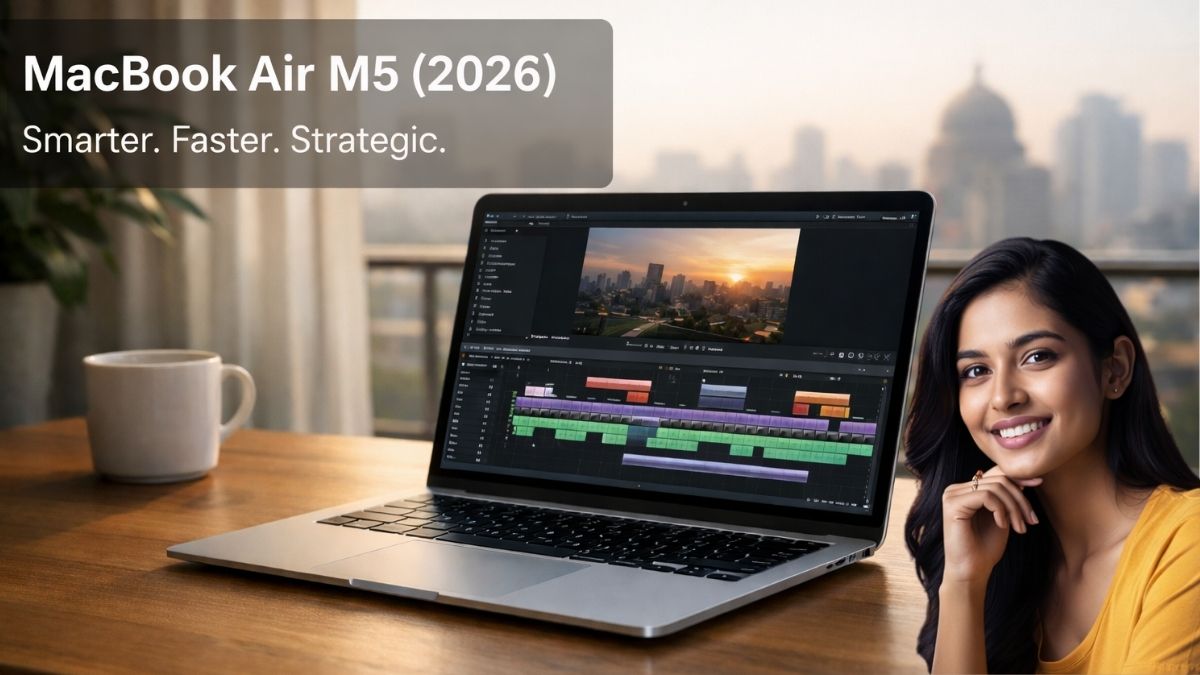

The MacBook Air M5 is Apple’s latest refresh of its most popular laptop, and in 2026, it’s less about flashy redesigns and more about strategic evolution. Powered by Apple’s next-generation M5 silicon, this model sharpens performance, extends efficiency, and quietly reinforces Apple’s dominance in the thin-and-light segment. For Indian students, developers, startup founders, and even US-based remote workers, this is the machine most will actually buy.
And that’s precisely why it matters.
Apple isn’t chasing spectacle here. It’s reinforcing its strongest product category — one that consistently outsells the Pro models globally and in India’s growing premium laptop segment.
- What Is the MacBook Air M5?
- M5 Silicon: Incremental on Paper, Strategic in Reality
- Real-World Performance: Where You’ll Actually Notice It
- Design: No Drama, Just Refinement
- Battery Life: Still the Segment Benchmark
- How the MacBook Air M5 Compares to the M3 and M4 Models
- Pricing in India: The Real Conversation
- Who Should Buy the MacBook Air M5?
- AI Acceleration: Quiet but Important
- Thermal Behavior: Still Fanless, Still Stable
- Is the MacBook Air M5 Worth It in 2026?
- Market Positioning: Apple’s Quiet Domination
- Forward Outlook: What Happens Next?
- FAQs
What Is the MacBook Air M5?
The MacBook Air M5 is Apple’s 2026 iteration of its ultra-portable laptop lineup, built around the new M5 chip. It delivers faster CPU and GPU performance, improved on-device AI processing, and better power efficiency while retaining the lightweight Air design. It’s positioned as a premium everyday laptop for students, professionals, and creators who don’t need a MacBook Pro.
That’s the short answer. But the context is more interesting.
M5 Silicon: Incremental on Paper, Strategic in Reality
Apple’s M-series chips have matured. The jump from M1 to M2 was dramatic. M2 to M3 refined performance. M4 focused on AI acceleration. The M5, based on Apple’s next-generation 3nm architecture refinement, feels like the most balanced version yet.
On paper, improvements look measured:
Upgraded 10-core CPU (higher efficiency cluster optimization)
Up to 12-core GPU option
Faster unified memory bandwidth
Improved Neural Engine throughput
Lower sustained thermals without fan redesign
But context matters.
For Indian buyers especially, the MacBook Air has become a status-neutral productivity machine. It’s no longer aspirational luxury — it’s practical premium. College students in Delhi University, startup teams in Bengaluru, and freelancers in Mumbai are choosing Air over Windows machines in the ₹95,000–₹1.25 lakh range because macOS stability and battery life consistently outperform rivals.
M5 strengthens that narrative rather than reinventing it.
Real-World Performance: Where You’ll Actually Notice It
Synthetic benchmarks don’t tell the full story. What matters is workflow.
Xcode compilation times drop further compared to M3 Air.
Adobe Lightroom batch exports are smoother.
4K timeline scrubbing in Final Cut Pro feels more consistent.
Chrome with 25 tabs open doesn’t spike thermals as aggressively.
For a Delhi-based YouTuber editing travel vlogs or a Gurugram startup engineer compiling builds on the go, this difference is tangible. Not dramatic. But reliable.
That’s the point. The Air doesn’t chase peak power — it optimizes sustained performance under light thermal constraints.
Design: No Drama, Just Refinement
Apple hasn’t overhauled the chassis. The flat-edged aluminum design introduced a few generations ago remains intact. It still comes in 13-inch and 15-inch variants.
However, subtle improvements stand out:
Slightly brighter Liquid Retina display
Improved webcam with enhanced computational HDR
Refined speaker tuning for spatial audio clarity
Wi-Fi 7 support for future-ready connectivity
Weight remains comfortably under 1.3 kg for the 13-inch model, which keeps it one of the easiest laptops to carry daily.
And frankly, that portability is half the appeal.
Battery Life: Still the Segment Benchmark
The MacBook Air M5 continues to deliver all-day battery life, with Apple claiming up to 18–20 hours of video playback.
Here’s the practical reality:
For mixed usage — Chrome, Zoom, Slack, light editing — Indian users can comfortably get a full workday without reaching for the charger. In tier-2 cities where power backup isn’t always seamless, that reliability matters more than peak CPU scores.
Windows competitors are improving. Qualcomm’s ARM-based chips are making progress. But Apple’s vertical integration still gives it an edge in battery optimization.
How the MacBook Air M5 Compares to the M3 and M4 Models
| Feature | MacBook Air M3 | MacBook Air M4 | MacBook Air M5 |
|---|---|---|---|
| Architecture | 3nm Gen 1 | 3nm Refined | 3nm Advanced |
| AI Performance | Strong | Very Strong | Best in Air lineup |
| GPU Options | Up to 10-core | Up to 10-core | Up to 12-core |
| Wi-Fi | Wi-Fi 6E | Wi-Fi 6E | Wi-Fi 7 |
| Battery | Excellent | Excellent | Slightly improved |
If you’re on M1 or Intel, upgrading is a no-brainer.
If you’re on M3, the jump is evolutionary, not essential.
M4 owners can safely skip this generation unless AI workloads matter heavily.
That’s a rare case of restraint from Apple’s upgrade cycle.
Pricing in India: The Real Conversation
Apple’s Air lineup typically starts around ₹99,900 in India, depending on base storage and RAM. With the M5, pricing is expected to hover around that same psychological threshold.
But here’s where things get interesting.
For a Delhi buyer comparing:
A high-end Windows ultrabook at ₹1,05,000
A base MacBook Air M5 at around ₹99,900
The resale value difference alone tilts the equation toward Apple. MacBooks in India hold resale shockingly well — sometimes 60% of value after three years.
That’s not just brand perception. It’s ecosystem stickiness.
Who Should Buy the MacBook Air M5?
The MacBook Air M5 is ideal for students, coders, content creators, and office professionals who prioritize portability, battery life, and long-term reliability over raw GPU horsepower. It handles everyday productivity, moderate creative work, and development workflows without thermal throttling, making it one of the most balanced premium laptops in 2026.
If you need sustained 3D rendering, heavy video production, or AI model training locally, look at a MacBook Pro.
If you need a dependable daily driver that won’t age badly in three years — this is it.
AI Acceleration: Quiet but Important
Apple is increasingly positioning macOS around on-device AI. The M5 chip improves Neural Engine throughput, which enhances:
Real-time transcription
Smart photo editing suggestions
AI-assisted coding tools
System-level voice processing
This doesn’t scream headline material. But as Apple continues to integrate deeper AI tools into macOS, the Air’s hardware foundation becomes future-proof.
In India’s rapidly growing AI startup ecosystem, lightweight AI inference capability on a portable machine matters more than we admit.
Thermal Behavior: Still Fanless, Still Stable
One of the most impressive aspects of the Air lineup is its fanless design.
The MacBook Air M5 maintains this architecture. Despite higher GPU options, Apple’s efficiency gains keep sustained workloads within safe thermal limits.
During 30-minute video exports, the machine gets warm — but not uncomfortable. And it rarely throttles aggressively under typical productivity loads.
Silence is underrated. Especially in shared offices or libraries.
Is the MacBook Air M5 Worth It in 2026?
Yes — if you’re upgrading from Intel or M1.
The MacBook Air M5 offers better performance, improved AI processing, and future-ready connectivity while maintaining exceptional battery life and portability. It’s not revolutionary, but it’s strategically refined. For most buyers in India and the US, it’s the safest premium laptop choice in 2026.
That’s the honest answer.
Market Positioning: Apple’s Quiet Domination
Apple understands something critical: most users don’t need a Pro.
By making the Air “good enough” for 80% of tasks, Apple captures students, first-job professionals, remote workers, and startup teams.
Meanwhile, Windows OEMs are fighting price wars or chasing experimental form factors.
The Air stays boring — in the best way possible.
And boring, in computing, often means dependable.
Forward Outlook: What Happens Next?
The M5 generation signals consolidation, not disruption.
Expect:
Deeper AI integration at the OS level
More aggressive education pricing in India
Continued ARM dominance pressure on Windows laptops
Possibly OLED displays in future Air iterations
The MacBook Air line is no longer Apple’s entry point. It’s the backbone.
If Apple keeps iterating at this pace — refining silicon, optimizing software, and holding pricing steady — it may lock down the premium ultraportable segment globally for another five years. That’s not flashy. It’s strategic.
Click to Read More: iPhone 17e Is Here: $599 / ₹64,900 Gets You Apple’s Most Powerful Budget iPhone Ever Built
FAQs
1. Is the MacBook Air M5 good for students in India?
Yes, the MacBook Air M5 is an excellent choice for Indian students in 2026. It offers long battery life, lightweight portability, and strong performance for coding, research, presentations, and light creative work. For most university workloads, it’s more than powerful enough and will easily last 4–5 years.
2. What is the difference between MacBook Air M5 and M4?
The MacBook Air M5 delivers improved CPU efficiency, slightly stronger GPU options, better AI acceleration, and Wi-Fi 7 support compared to M4. While the performance boost isn’t dramatic for everyday tasks, sustained workloads and AI-based features feel smoother and more future-ready.
3. Is the MacBook Air M5 powerful enough for video editing?
Yes — for light to moderate editing. The MacBook Air M5 handles 4K editing in Final Cut Pro and Adobe Premiere Pro smoothly, especially for YouTube creators. However, for heavy professional-grade workflows with complex color grading or multi-cam editing, a MacBook Pro is still better.
4. How much will the MacBook Air M5 cost in India?
Apple typically prices the base MacBook Air around ₹99,900 in India. The M5 model is expected to stay within that range, depending on RAM and storage configuration. Higher-spec models can cross ₹1.25 lakh.
5. Should I upgrade from MacBook Air M3 to M5?
If you’re on M3, upgrading isn’t essential unless you need improved AI processing or better GPU performance. The jump is evolutionary, not transformational. However, Intel and M1 users will see a significant performance and efficiency upgrade.