
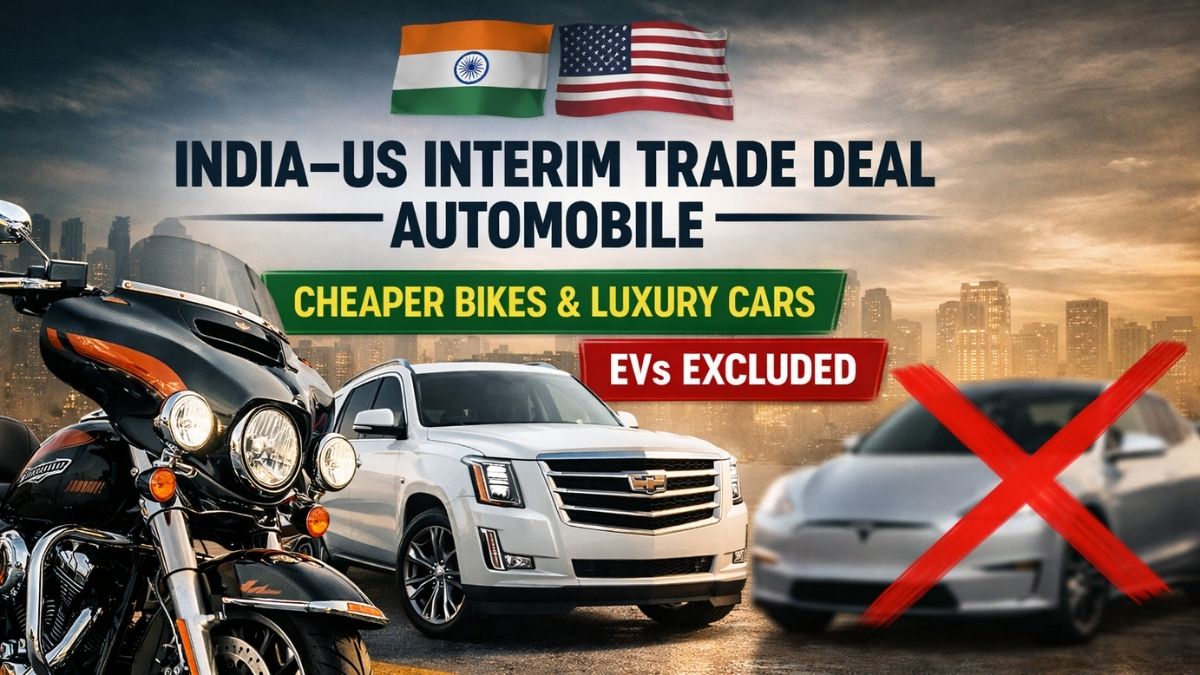

- India–US Interim Trade Deal Could Reshape India’s Auto Market: Bikes Get Cheaper, EVs Stay Out
- India US Interim Trade Deal Automobile: What Exactly Is Being Negotiated?
- Why American Motorcycles Are the Biggest Winners
- High-End American Cars: Limited but Strategic Gains
- Why Electric Vehicles Are Excluded — By Design
- Comparison Table: Who Gains and Who Doesn’t?
- Why This Matters
- Future Impact: What Happens After the Interim Deal?
- Conclusion
- FAQs
- 1. What is the India US interim trade deal automobile agreement?
- 2. How will the India US interim trade deal automobile impact Indian consumers?
- 3. Which vehicles benefit most from the India US interim trade deal automobile?
- 4. Why are electric vehicles excluded from the India US interim trade deal automobile?
- 5. Does the India US interim trade deal automobile affect Tesla’s India entry?
- 6. Is the India US interim trade deal automobile a permanent agreement?
- 7. How does the India US interim trade deal automobile impact Indian manufacturers?
India–US Interim Trade Deal Could Reshape India’s Auto Market: Bikes Get Cheaper, EVs Stay Out
India US interim trade deal automobile sector is on the brink of a selective but potentially disruptive transformation as New Delhi and Washington move closer to sealing a limited yet strategic trade agreement. For India’s premium vehicle buyers, the implications are immediate and tangible: large American motorcycles and select high-end US cars could finally see meaningful price corrections.
However, for electric vehicles — especially globally watched brands like Tesla — the door remains firmly shut. This contrast reveals far more than tariff tweaks. It exposes India’s long-term industrial priorities, its insistence on local manufacturing, and a carefully calibrated approach to trade liberalisation.
India US Interim Trade Deal Automobile: What Exactly Is Being Negotiated?
The India US interim trade deal automobile discussion is part of a broader effort to revive bilateral trade momentum without committing immediately to a full Free Trade Agreement (FTA). Instead of sweeping concessions, both countries are focusing on low-friction sectors where consensus is easier to achieve.
Key characteristics of this interim pact:
Limited sector coverage
Faster implementation timeline
Designed as a confidence-building step toward a future FTA
Automobiles — particularly premium imports — have emerged as one of the earliest convergence points.
Why American Motorcycles Are the Biggest Winners
The Current Problem: Punitive Import Duties
At present, motorcycles above 800cc attract around 50% customs duty in India. This has kept iconic American cruisers far more expensive than in global markets.
Brands affected include:
Harley-Davidson
Indian Motorcycle
What the Interim Deal Changes
Under the proposed agreement:
Import duty on large US motorcycles could drop to zero
Ex-showroom prices may fall by 30–40%
Dealer viability and demand could return rapidly
Direct-answer snippet:
Large American motorcycles could become significantly cheaper in India if zero-duty access is implemented under the interim trade deal.
For Harley-Davidson — which struggled earlier due to pricing and scale — this could mark a meaningful re-entry moment.
High-End American Cars: Limited but Strategic Gains
India currently imposes 60–100% import duties on fully built cars, making US-made luxury vehicles uncompetitive against European rivals.
While mass-market American brands are largely absent, tariff relief could:
Enable niche CBU imports
Support limited-volume luxury launches
Increase competition in the ₹1 crore-plus segment
This shift primarily benefits affluent buyers but also sends a signal that India is selectively opening its premium auto market.
Why Electric Vehicles Are Excluded — By Design
Despite intense lobbying, electric vehicles remain outside the scope of the interim pact.
India’s Clear Policy Line
India’s government has repeatedly stated that EV concessions will be linked to:
Local manufacturing commitments
Battery ecosystem investments
Supply-chain localisation
Reducing EV import duties without these safeguards could derail domestic capacity-building.
Direct-answer snippet:
Electric vehicles are excluded from the India–US interim trade deal to protect India’s domestic EV manufacturing ambitions.
For Tesla, this means high prices remain unless local production plans materialise.
Comparison Table: Who Gains and Who Doesn’t?
| Segment | Impact Level | Outcome |
|---|---|---|
| American motorcycles | Very high | Zero-duty, major price cuts |
| US luxury cars | Moderate | Selective tariff relief |
| Electric vehicles | None | High duties remain |
| Domestic premium brands | Mixed | Increased competition |
Why This Matters
The India US interim trade deal automobile conversation highlights India’s two-speed trade strategy:
Open premium, non-strategic segments
Protect future-critical industries like EVs
For consumers, this means better choice and pricing at the top end.
For manufacturers, the message is blunt: India rewards localisation, not pure imports.
Geopolitically, the deal strengthens alignment between India and the United States amid shifting global supply chains.
Future Impact: What Happens After the Interim Deal?
Short Term
Price corrections in premium bikes
Renewed interest from US niche auto players
Medium Term
Pressure on Indian premium motorcycle brands
Fresh EV negotiations tied to local factories
Long Term
Interim pact becomes foundation for a full FTA
Auto sector shapes broader trade liberalisation
Conclusion
The India–US interim trade agreement is not a blanket opening of India’s auto market — it is a calculated, sector-specific intervention. By cutting duties on American motorcycles and select luxury cars while keeping EVs protected, India is balancing consumer benefit with industrial sovereignty.
For buyers dreaming of a Harley, the timing looks promising. For EV giants, the roadmap remains clear: build in India, or wait.
Click to Read More: The Ghosts of the Garage: 5 Legendary Skoda Cars India Still Misses
FAQs
1. What is the India US interim trade deal automobile agreement?
The India US interim trade deal automobile is a temporary bilateral trade arrangement between India and the United States aimed at reducing import duties on select automobile categories, especially premium motorcycles and high-end cars, while keeping electric vehicles outside the scope of immediate tariff benefits.
2. How will the India US interim trade deal automobile impact Indian consumers?
The India US interim trade deal automobile is expected to lower prices of imported American motorcycles and luxury cars in India, offering buyers more premium options at competitive prices, while maintaining protection for domestic EV manufacturing.
3. Which vehicles benefit most from the India US interim trade deal automobile?
Under the India US interim trade deal automobile, large-capacity American motorcycles and select luxury cars are the biggest beneficiaries, as they may see sharp customs duty reductions, unlike electric vehicles which remain excluded.
4. Why are electric vehicles excluded from the India US interim trade deal automobile?
Electric vehicles are excluded from the India US interim trade deal automobile because India wants global EV manufacturers to invest in local production rather than rely on imports, supporting long-term domestic manufacturing goals.
5. Does the India US interim trade deal automobile affect Tesla’s India entry?
Yes, the India US interim trade deal automobile does not offer tariff relief for imported EVs, meaning Tesla vehicles would still face high import duties unless local manufacturing plans are finalized.
6. Is the India US interim trade deal automobile a permanent agreement?
No, the India US interim trade deal automobile is a short-term arrangement designed as a stepping stone toward a broader and more comprehensive India–US Free Trade Agreement in the future.
7. How does the India US interim trade deal automobile impact Indian manufacturers?
The India US interim trade deal automobile increases competition in the premium segment, pushing Indian manufacturers to innovate, while still protecting strategic sectors like electric vehicles.