

- Introduction
- The AI Revolution in Smartphone Cameras
- How Tensor AI Improves Smartphone Photography in Real Time
- Feature Breakdown: Tensor AI Camera Capabilities
- Portrait Photography: Precision Depth and Realism
- Motion Deblur and Real-Time Correction
- AI Editing Tools: Post-Capture Intelligence
- Why This Matters
- Market Context: AI as the New Camera Standard (2025–2026)
- What Happens Next: Future Impact of Tensor AI
- Conclusion
- FAQs
- Q1. What does How Tensor AI improves smartphone photography actually mean?
- Q2. How Tensor AI improves smartphone photography in low-light conditions?
- Q3. How Tensor AI improves smartphone photography for portraits?
- Q4. How Tensor AI improves smartphone photography compared to traditional processors?
- Q5. How Tensor AI improves smartphone photography for moving subjects?
- Q6. Does How Tensor AI improves smartphone photography also apply to video?
- Q7. Why is How Tensor AI improves smartphone photography important in 2026?
- Q8. Will How Tensor AI improves smartphone photography continue evolving?
Introduction
How Tensor AI improves smartphone photography is redefining the way modern smartphones capture, process, and enhance images in real time. In 2026, this matters more than ever as AI-powered chipsets — particularly those designed by Google — are pushing computational photography beyond traditional hardware limits, impacting everyday users, content creators, and mobile-first journalists alike.
Smartphone cameras are no longer judged by megapixels alone. Today, AI-driven image processing determines clarity, color accuracy, night performance, and even emotional tone. Tensor-powered devices have accelerated this shift, making software intelligence the true differentiator in the flagship smartphone market.
The AI Revolution in Smartphone Cameras
Smartphone photography entered a new phase when dedicated AI silicon became integrated directly into chipsets. Unlike generic mobile processors, Tensor chips prioritize machine learning tasks, especially real-time image enhancement.
Devices such as the Google Pixel 8 Pro and newer Pixel models showcase how tightly integrated AI hardware transforms photography. Instead of merely capturing an image, the device interprets scenes, predicts optimal exposure, reconstructs missing details, and refines output in milliseconds.
This evolution reflects a broader 2025–2026 market shift:
AI is no longer an add-on feature — it is the camera engine.
How Tensor AI Improves Smartphone Photography in Real Time
1. Scene Understanding Before You Press the Shutter
Tensor AI continuously analyzes:
Lighting conditions
Subject movement
Background complexity
Skin tone variations
Facial expressions
The system applies semantic segmentation to treat different parts of the frame independently — sky, skin, fabric, shadows — each optimized uniquely.
Direct Answer (Featured Snippet Optimized):
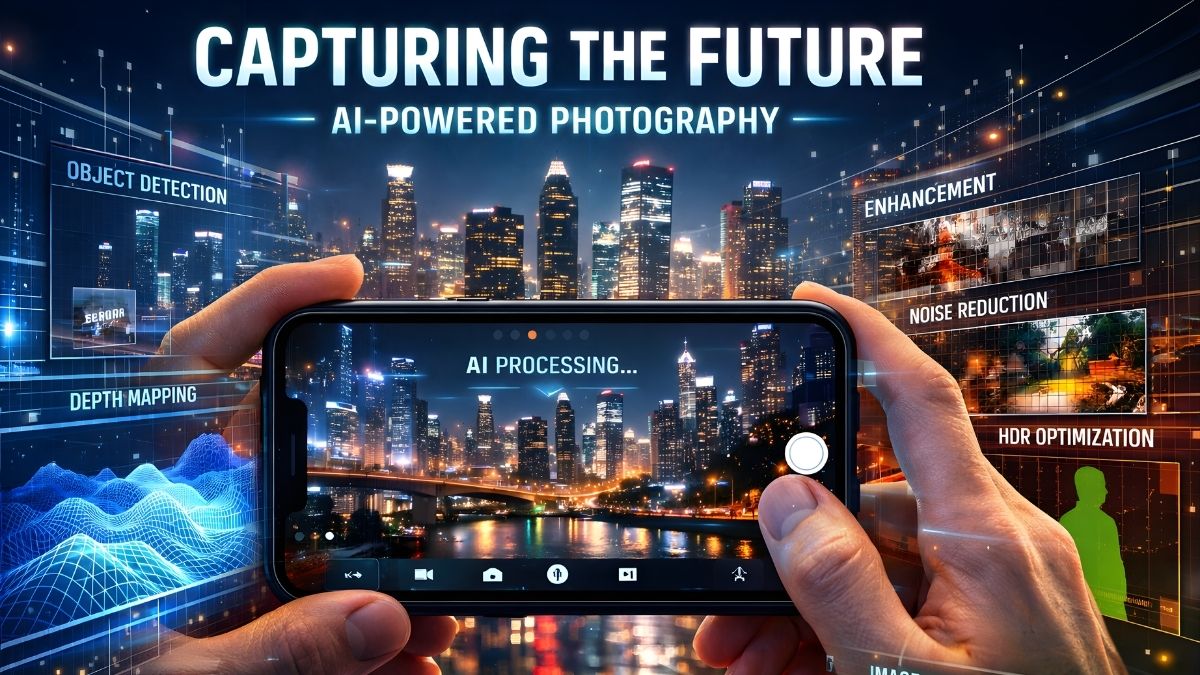
How Tensor AI improves smartphone photography is primarily through real-time scene analysis. The AI identifies subjects, lighting conditions, and textures before the image is captured, then dynamically adjusts exposure, color balance, and detail processing to produce a sharper and more natural-looking photo.
2. Advanced HDR and Dynamic Range Expansion
Traditional HDR stacks multiple images. Tensor AI predicts highlight and shadow recovery before final rendering.
This results in:
Better sky retention
Cleaner indoor window shots
Reduced blown-out highlights
More balanced portraits in backlit scenes
The improvement is particularly noticeable in high-contrast urban photography and travel scenarios.
3. Night Photography Without Tripods
Night mode has become a benchmark feature in flagship phones. Tensor AI reduces noise through intelligent multi-frame fusion while preserving fine textures like hair strands and fabric patterns.
Direct Answer:
How Tensor AI improves smartphone photography at night is by combining multiple low-light frames with AI-driven noise reduction and detail reconstruction. This allows brighter, sharper images in dark environments without requiring a tripod or manual adjustments.
Feature Breakdown: Tensor AI Camera Capabilities
| Feature | Traditional Processing | Tensor AI Processing |
|---|---|---|
| HDR | Simple multi-frame merge | AI scene-aware HDR fusion |
| Night Mode | Long exposure stacking | Predictive noise reduction + texture recovery |
| Portrait Mode | Basic edge detection | Semantic depth mapping with hair precision |
| Skin Tone Accuracy | Fixed color tuning | AI-trained inclusive skin tone calibration |
| Motion Capture | Shutter-speed dependent | AI motion deblur algorithms |
This shift shows why AI silicon is now a competitive moat rather than a marketing feature.
Portrait Photography: Precision Depth and Realism
Tensor AI enhances portrait photography through advanced edge detection and natural depth simulation.
Hair strands, glasses, and translucent fabrics are detected more accurately than in earlier generations. Skin tone representation has also improved significantly due to AI datasets trained on diverse subjects.
In 2026, consumers increasingly prioritize natural skin rendering over artificial beautification filters — a subtle but powerful shift in user expectations.
Motion Deblur and Real-Time Correction
Children, pets, and sports moments are notoriously difficult to capture. Tensor AI predicts motion patterns and reconstructs blurred areas using machine learning models trained on millions of scenarios.
Direct Answer:
How Tensor AI improves smartphone photography for moving subjects is by using AI-based motion deblur. The system analyzes movement patterns during capture and reconstructs blurred sections, producing clearer images even when the subject is in motion.
AI Editing Tools: Post-Capture Intelligence
Tensor’s capabilities extend beyond capturing images. AI-powered editing tools enable:
Background replacement
Magic object removal
Facial expression blending
AI-powered sharpening
This reduces reliance on third-party editing apps and shortens workflow for creators.
The integration between hardware and AI software is where Tensor stands apart from competitors using generic chipsets.
Why This Matters
The importance of How Tensor AI improves smartphone photography extends beyond casual snapshots.
1. Market Impact
Flagship smartphones now compete on AI performance more than raw camera sensors.
2. Creator Economy
Short-form video and social content demand instant, high-quality output. AI reduces editing time dramatically.
3. Accessibility
Users without photography expertise can achieve professional-grade results.
4. Competitive Landscape
Brands that fail to invest in dedicated AI silicon risk falling behind in camera innovation by 2027.
Market Context: AI as the New Camera Standard (2025–2026)
Industry trends indicate:
Dedicated AI processing units are becoming mandatory in premium devices.
Computational photography patents are increasing year-over-year.
AI camera marketing budgets are rising faster than sensor technology investments.
In short, the camera is now software-defined.
What Happens Next: Future Impact of Tensor AI
Looking ahead to 2027–2028:
Real-time video HDR enhancement will become standard.
AI-generated background depth in video calls will improve dramatically.
Multi-camera fusion using AI will create DSLR-like output from slim devices.
Personalized image tuning based on user preference patterns may emerge.
The next frontier is predictive photography — where the device anticipates the perfect moment before the user reacts.
Conclusion
How Tensor AI improves smartphone photography is not a minor upgrade — it represents a structural transformation in how images are captured and processed. By combining dedicated AI silicon with computational photography software, Tensor-powered devices have elevated smartphone cameras into intelligent imaging systems.
As AI chips mature and machine learning models grow more sophisticated, the gap between professional cameras and smartphones will narrow even further. The future of photography is no longer about lenses alone — it’s about learning algorithms working invisibly behind every shot.
Click to Find More: Google Pixel 10a: The Breakthrough Mid-Range Upgrade of 2026
FAQs
Q1. What does How Tensor AI improves smartphone photography actually mean?
How Tensor AI improves smartphone photography refers to the use of dedicated AI processing inside smartphones to enhance image quality through scene detection, HDR optimization, and intelligent detail reconstruction. It means photos are improved by machine learning rather than hardware alone.
Q2. How Tensor AI improves smartphone photography in low-light conditions?
How Tensor AI improves smartphone photography in low light is through multi-frame image fusion combined with AI-based noise reduction. The system captures several frames instantly, merges them intelligently, and restores lost detail while keeping colors accurate and natural.
Q3. How Tensor AI improves smartphone photography for portraits?
How Tensor AI improves smartphone photography in portrait mode is by using semantic depth mapping and advanced edge detection. It separates subjects from backgrounds more precisely, preserving fine details like hair strands and improving skin tone representation.
Q4. How Tensor AI improves smartphone photography compared to traditional processors?
How Tensor AI improves smartphone photography compared to traditional image processors is through adaptive learning models. Instead of relying on fixed algorithms, it continuously analyzes lighting, motion, and subject data to optimize every shot dynamically.
Q5. How Tensor AI improves smartphone photography for moving subjects?
How Tensor AI improves smartphone photography for motion shots is by using predictive motion deblur technology. The AI analyzes subject movement patterns and reconstructs blurred areas, helping users capture clearer images of fast-moving objects.
Q6. Does How Tensor AI improves smartphone photography also apply to video?
Yes. How Tensor AI improves smartphone photography extends to video recording as well. It enhances HDR video, stabilizes footage intelligently, and adjusts exposure in real time to produce smoother and more cinematic results.
Q7. Why is How Tensor AI improves smartphone photography important in 2026?
How Tensor AI improves smartphone photography is especially important in 2026 because AI processing has become the main competitive advantage in flagship smartphones. Camera performance is now defined more by AI capability than by megapixel count.
Q8. Will How Tensor AI improves smartphone photography continue evolving?
Yes. How Tensor AI improves smartphone photography is expected to evolve further with personalized image tuning, smarter real-time enhancements, and improved multi-camera fusion as AI models become more advanced in the coming years.




1 thought on “How Tensor AI Improves Smartphone Photography: The Game-Changing Power Behind 2026 Flagships”