
- How to Prepare for AEES Teacher Exam Preparation 2026: Syllabus & Mock Tips
- Understand the AEES Exam Pattern Before Preparing
- Step 1: Download the Correct Official Syllabus
- AEES PRT Preparation Strategy
- AEES TGT Preparation Strategy
- AEES PGT Preparation Strategy
- Balvatika Teacher, Librarian and Leadership Preparation
- Step 2: Give More Time to the Highest-Marked Sections
- AEES 30-Day Study Plan 2026
- Step 3: Practise Mock Tests the Right Way
- Step 4: Prepare for the Teaching Skill Test
- Step 5: Understand Qualifying Marks Without Confusing Them With Cutoffs
- Common AEES Preparation Mistakes to Avoid
- AEES Exam Preparation 2026 FAQs
- Final Preparation Advice
How to Prepare for AEES Teacher Exam Preparation 2026: Syllabus & Mock Tips
Preparing for the AEES Teacher Exam 2026 requires more than completing a general teaching-exam syllabus. The Atomic Energy Education Society has published separate syllabi for different posts, and the recruitment notification specifies how the Computer-Based Test (CBT) and subsequent selection stages will work.
Under Recruitment Notification 01/2026, AEES has announced 254 tentative vacancies for Principal, Vice-Principal, PGT, TGT, Primary Teacher, Librarian, PRT Music and Balvatika Teacher positions.
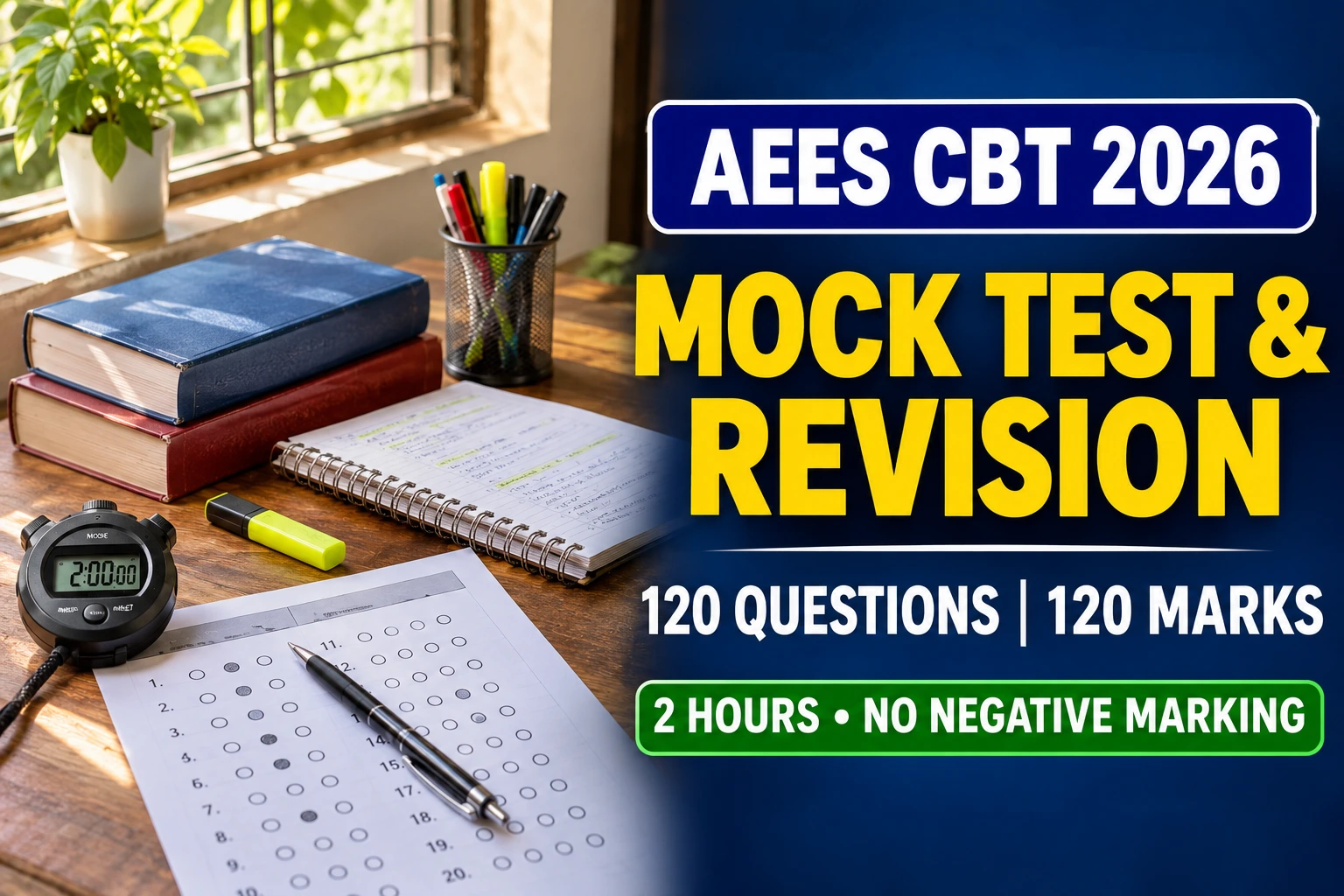
For most teaching posts, the CBT consists of 120 questions worth 120 marks, to be completed in two hours. There is no negative marking. However, the subject-specific section accounts for 75 marks, making targeted preparation especially important.
This guide explains how to organize your preparation, choose appropriate study materials, practise mock tests and build a flexible 30-day study plan.
Important: AEES has not announced the CBT date in Notification 01/2026. The 30-day plan below is a suggested preparation cycle, not an official examination schedule.
Understand the AEES Exam Pattern Before Preparing
The following pattern applies to PGT, TGT, Librarian, PRT, PRT Music and Balvatika Teacher posts.
| Examination Section | Questions | Marks |
|---|---|---|
| General English | 5 | 5 |
| General Hindi | 5 | 5 |
| General Reasoning | 5 | 5 |
| General Knowledge | 5 | 5 |
| Basic Computer Literacy | 5 | 5 |
| Numerical Ability | 5 | 5 |
| Teaching Methodology | 15 | 15 |
| Subjects Concerned | 75 | 75 |
| Total | 120 | 120 |
Duration: 120 minutes. Negative marking: None.
The advertised distribution makes subject knowledge the largest component at 62.5% of the total marks. Teaching Methodology represents 12.5%, while the six general sections collectively account for 25%.
These percentages describe the notification’s test structure. They do not establish that every individual topic within a subject will receive an equal number of questions.
Candidates preparing for Principal or Vice-Principal positions must follow a different 150-question, 150-mark pattern covering school leadership, teaching-learning processes, administration, finance and other prescribed areas.
Step 1: Download the Correct Official Syllabus
Start by opening the AEES recruitment webpage and downloading the syllabus for your exact post and subject.
Do not rely only on the syllabus of another teaching examination. Although topics may overlap with CTET, KVS or other examinations, AEES has issued its own detailed subject-wise documents.
Create a simple tracking sheet with four columns: syllabus topic, current preparation level, questions practised and revision status.
Mark topics as complete only after you can explain the concept and answer representative questions without relying on notes.
AEES PRT Preparation Strategy
The official PRT syllabus covers English comprehension and language usage, Hindi, Mathematics and The World Around Us (TWAU).
The English section of the syllabus includes reading comprehension, writing ability, grammar, sentence structure, tenses, reported speech and error correction. Hindi covers literature, comprehension and grammar.
Mathematics includes number operations, fractions, measurement, geometry, percentages, ratios, statistics and related areas. TWAU covers environmental awareness, society, science-related concepts, history, governance, art, health and physical activities.
Recommended approach:
Begin with mathematics and TWAU topics where your basic concepts are weak. Practise reading comprehension, grammar correction and vocabulary regularly rather than leaving languages until the final week.
For mathematics, alternate conceptual questions with time-bound problem solving. For TWAU, use short revision notes, diagrams and everyday examples to connect ideas.
Also reserve a separate daily period for Teaching Methodology and the general CBT sections.
AEES TGT Preparation Strategy
TGT candidates must follow the syllabus for their specific combination or specialization.
For example, the official TGT Mathematics–Physics syllabus includes real numbers, polynomials, matrices, vector spaces, calculus, trigonometry, statistics, probability, mechanics, electricity and magnetism.
This means that limiting preparation to lower-secondary school textbooks would leave some notified material uncovered.
Similarly, the TGT Social Studies syllabus includes History, Geography, Civics/Political Science and Economics. Candidates should distribute their preparation across all four areas rather than concentrating on only one.
Recommended approach:
Divide the official syllabus into small topic groups. For a combined subject, maintain separate revision sheets for each discipline.
Practise conceptual, numerical and application-oriented questions where relevant. After every revision session, review the questions answered incorrectly and identify whether the problem came from missing knowledge, misreading or calculation.
Other TGT specializations, including languages, Computer Science, Art Education and Physical & Health Education, require their own syllabus-specific study plans.
AEES PGT Preparation Strategy
PGT preparation should reflect the depth and scope of the notified subject syllabus.
For example, the official PGT Biology syllabus includes cell biology, genetics, evolution, human physiology, reproduction, ecology and biotechnology.
The documents also specify individual inclusions and exclusions. Candidates should therefore read topic descriptions carefully instead of assuming that every chapter from a general postgraduate textbook will be examined.
Recommended approach:
Start by mapping the official syllabus to reliable undergraduate and postgraduate reference materials, as appropriate to the topic.
Focus on conceptual understanding, definitions, scientific reasoning and application questions. Use concise diagrams, comparison tables and formula sheets where useful.
After completing a topic, attempt a small set of related MCQs and review every error. Avoid collecting excessive study materials when the available time is better spent revising prescribed concepts.
Balvatika Teacher, Librarian and Leadership Preparation
Balvatika Teacher candidates should give particular attention to early-childhood development, ECCE, play-based learning, foundational literacy and numeracy, NCF-FS 2022, NEP 2020, inclusive education and child-friendly assessment.
Their official syllabus also includes classroom management, socio-emotional development, ICT and related educational awareness.
Librarian candidates should follow the official Library and Information Science syllabus, including library management, cataloguing, classification, information retrieval and computer applications.
Principal and Vice-Principal candidates need an independent approach. Their CBT assesses educational leadership, learner development, school organization, management, administration and financial responsibilities.
Leadership candidates should also practise explaining administrative decisions and real school-management situations because their selection process includes an interview.
Step 2: Give More Time to the Highest-Marked Sections
A practical study schedule for a candidate preparing for the 120-mark CBT can allocate time as follows:
| Daily Activity | Suggested Time |
|---|---|
| Concerned Subject | 2 hours 30 minutes |
| Teaching Methodology | 45 minutes |
| General Sections | 1 hour |
| Revision and Error Analysis | 45 minutes |
| Total | 5 hours |
This allocation is an editorial suggestion, not an official AEES instruction.
Students with stronger subject knowledge but weaker numerical ability or languages can adjust the schedule. The aim is to cover the entire syllabus without neglecting the areas that determine most of the marks.
Teaching Methodology preparation should develop the ability to interpret classroom situations and select appropriate teaching responses. Topics may include lesson planning, learner differences, assessment, inclusive teaching and learning approaches where supported by the applicable official syllabus.
AEES 30-Day Study Plan 2026
The following plan is a flexible 30-day preparation cycle. It can start on any date and should be adjusted when AEES announces the examination schedule.
| Days | Preparation Activities |
|---|---|
| 1–3 | Download official syllabus, assess weak areas, take a diagnostic test and organize resources |
| 4–7 | Complete the first set of high-need subject topics; begin Teaching Methodology and general-section practice |
| 8–10 | Study the next subject modules; solve topic-wise MCQs and revise earlier mistakes |
| 11–14 | Continue remaining subject modules and complete a timed sectional assessment |
| 15–17 | Revisit difficult concepts and practise mixed questions from the concerned subject |
| 18–21 | Cover unfinished syllabus areas; revise language, reasoning, numerical ability and computer basics |
| 22–24 | Attempt full-length CBT practice tests and analyze time spent in each section |
| 25–27 | Revise weak topics using the error notebook; practise teaching explanations or leadership responses as applicable |
| 28–29 | Attempt final timed mock tests; revise formulas, definitions and short notes |
| 30 | Review key concepts, check official updates and avoid unnecessary new materials |
A 30-day plan is useful for organizing study, but it does not guarantee complete coverage for candidates beginning a large syllabus from scratch.
If more preparation time is available, extend the first two phases. If the examination is announced with less time remaining, concentrate on the already completed syllabus, error correction and representative practice rather than rushing through new resources.
Step 3: Practise Mock Tests the Right Way
A useful AEES mock-test routine has three stages.
First, practise by topic. After completing a chapter or unit, attempt questions related to that area. Review the underlying concept immediately after checking your answers.
Second, practise by section. Use short timed sessions for the general subjects, Teaching Methodology and concerned subject. This makes it easier to identify which area slows you down.
Third, practise the full examination. For the standard teaching-post CBT, use a 120-question, 120-minute mock format. Principal and Vice-Principal candidates should practise their separate 150-question format over 150 minutes.
Because AEES specifies no negative marking, unanswered questions offer no scoring advantage. During practice, answer confident questions first, revisit difficult ones and use any remaining time to make a reasoned choice for every question.
After each mock, record your score, unanswered questions, wrong answers, slowest sections and topics requiring revision.
AEES also states that a mock CBT practice link will be provided within eligible candidates’ login after the call letter is issued. This official practice facility should help candidates become familiar with the examination interface, although its sample questions may not match the actual paper’s standard.
Step 4: Prepare for the Teaching Skill Test
The selection process does not end with the CBT.
For PGT, TGT, Librarian, PRT, PRT Music and Balvatika Teacher posts, the notification prescribes a qualifying teaching-skill test on a Go/No Go basis.
Candidates are given a subject-oriented topic and must demonstrate their teaching ability through a chalk-and-board-based exercise.
A practical preparation method is to rehearse a short lesson that includes a clear introduction, accurate explanation, board organization, an example and a closing recap.
For instance, a Mathematics candidate could practise introducing fractions with a simple visual example, explaining the steps on a board and checking whether a learner understands the concept.
This is a suggested practice exercise, not an officially prescribed skill-test question or fixed demonstration duration.
Candidates awarded Go are considered for selection according to CBT merit. A No Go assessment prevents empanelment regardless of CBT performance.
For Principal and Vice-Principal, selection instead includes an interview, with final merit based on a 50:50 CBT–interview weightage under the applicable rules.
Step 5: Understand Qualifying Marks Without Confusing Them With Cutoffs
The notification initially prescribes CBT shortlisting standards of 60% for UR/EWS vacancies and 54% for SC/ST/OBC/PwBD vacancies, subject to the stated category and recruitment conditions.
AEES reserves the right to lower these standards under specified circumstances, within the minimum limits mentioned in the advertisement.
These percentages are qualifying or shortlisting standards, not final selection cutoffs.
Meeting the minimum percentage alone does not guarantee an invitation to the interview or skill test. The recruitment rules also limit the number of candidates invited according to merit and vacancy numbers.
Candidates should therefore prepare for the strongest achievable score rather than treating the qualifying percentage as a safe selection target.
Common AEES Preparation Mistakes to Avoid
Avoid using an outdated 100-question pattern when the 2026 notification specifies 120 questions for most teaching posts.
Do not study only Teaching Methodology while neglecting the 75-mark subject section. Conversely, do not ignore the general sections simply because they have fewer marks individually.
Avoid treating unofficial question sets as authenticated AEES previous-year papers. The official recruitment page also contains material from promotion-quota examinations, which should not automatically be considered equivalent to the current direct-recruitment CBT.
Finally, do not postpone lesson-demonstration practice until after CBT results. Short, regular rehearsals can make the eventual skill-test preparation more manageable.
AEES Exam Preparation 2026 FAQs
How should I start AEES Teacher Exam preparation?
Download the syllabus for your exact post, review the official CBT pattern, take a diagnostic test and divide the syllabus into manageable weekly targets.
Is 30 days enough to prepare for AEES 2026?
It depends on previous subject knowledge, available study hours and syllabus coverage. The suggested 30-day plan is a structured revision and preparation cycle, not a promise of readiness.
Which section carries the most marks in the AEES teacher exam?
For PGT, TGT, Librarian, PRT, PRT Music and Balvatika Teacher posts, the Subjects Concerned section carries 75 of the 120 marks.
Is there negative marking in AEES Recruitment 2026?
No. Recruitment Notification 01/2026 specifies no negative marking in the CBT.
Is CTET preparation enough for the AEES exam?
No. CTET may provide useful teaching-related foundations, but candidates must also prepare the specific subject syllabus, general sections and selection requirements notified by AEES.
What happens after the AEES CBT?
Shortlisted candidates appear for an interview or qualifying skill test, depending on the post. Meeting the CBT qualifying standard does not guarantee shortlisting.
Final Preparation Advice
Effective AEES Teacher Exam Preparation 2026 begins with the official syllabus and a realistic assessment of your current knowledge.
Prioritize the concerned subject, practise the general sections consistently, review mistakes after every mock and prepare for the applicable skill test or interview.
Continue checking the AEES recruitment portal for the examination date, call letter and further official instructions.
Official References:
- Recruitment Notification 01/2026: https://www.aees.gov.in/DOCUMENTS/rv/1.%20AEES_Recruitment_Notice_01_2026_29.10.2026.pdf
- Official Subject-Wise Syllabus: https://aees.gov.in/recruitment.html
- AEES Application and Examination Portal: https://aees.onlineregistrationforms.com/
Verified on 2 November 2026 (IST). This is an independent preparation guide, not an official AEES coaching programme or examination timetable. Study schedules, practice examples and preparation priorities are editorial recommendations.
Read More>>> AEES Teacher Recruitment 2026: 254 Vacancies, Apply by November 22