
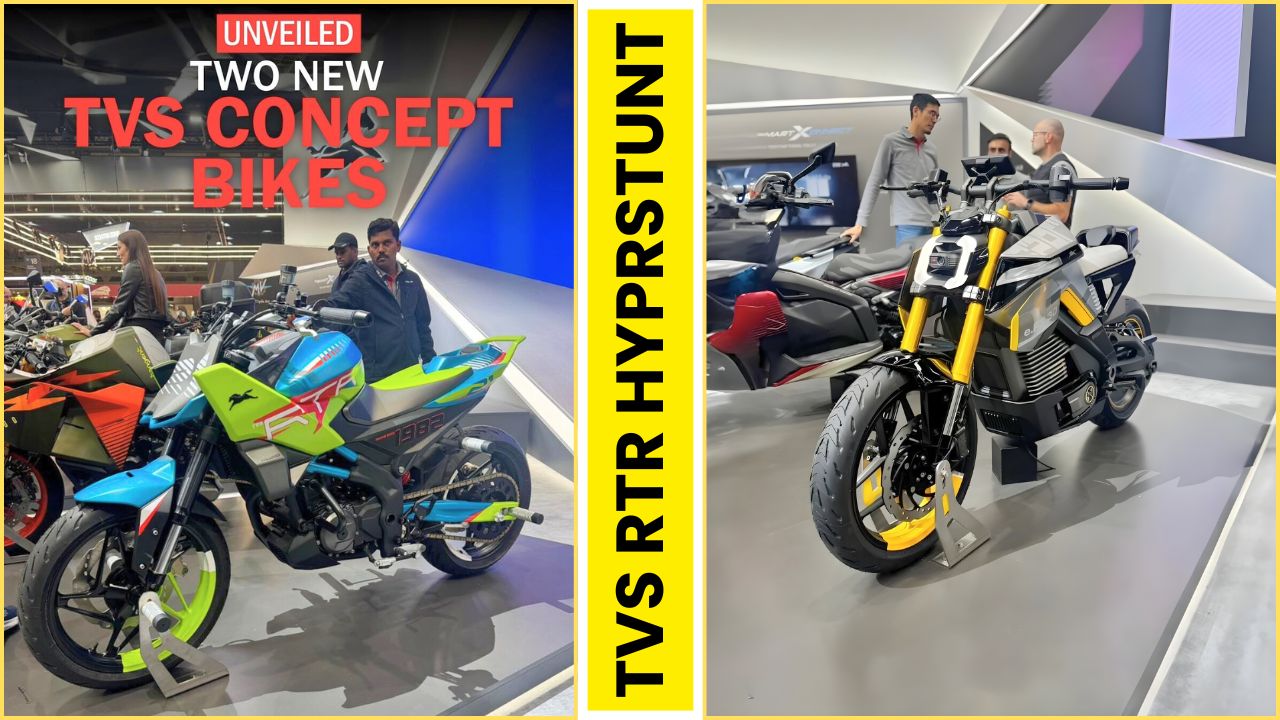

- TVS RTR HyprStunt: India’s First Purpose-Built Stunt Motorcycle Takes Shape
- From Concept to Commitment: The Significance of EICMA 2025
- Design Philosophy: Function Dictates Form
- Expected Engine Platform: Proven Power, Perfected for Control
- Chassis & Durability: Built for Impact, Not Just Acceleration
- Why the Indian Patent Filing Matters
- TVS and Performance Heritage: Why This Feels Authentic
- Potential Positioning and Target Audience
- Conclusion: A Defining Moment for Indian Motorcycling
- FAQs
- What is the TVS RTR HyprStunt motorcycle?
- Is the TVS RTR HyprStunt a concept or a production-ready bike?
- What makes the TVS RTR HyprStunt different from regular stunt-modified bikes?
- Which engine is expected in the TVS RTR HyprStunt?
- Will the TVS RTR HyprStunt be launched in India?
- Is the TVS RTR HyprStunt street legal?
- Who is the target audience for the TVS RTR HyprStunt?
- How could the TVS RTR HyprStunt impact stunt riding in India?
- What safety features can be expected on the TVS RTR HyprStunt?
- When is the expected launch date of the TVS RTR HyprStunt?
TVS RTR HyprStunt: India’s First Purpose-Built Stunt Motorcycle Takes Shape
The world of high-performance motorcycling has always thrived on innovation—lighter frames, sharper engines, better control systems. Yet, one segment has long remained overlooked by manufacturers: professional freestyle stunt riding. For decades, stunt riders have relied on heavily modified street motorcycles, often compromising safety, balance, and durability to perform extreme maneuvers.
TVS Motor Company is now challenging that norm.
With the unveiling of the TVS RTR HyprStunt at EICMA 2025, followed by the official filing of its design patent in India, TVS has signaled something far more ambitious than a concept showcase. This is a calculated step toward introducing India’s first factory-built stunt motorcycle, engineered from the ground up for control, resilience, and rider confidence in extreme riding conditions.
The HyprStunt doesn’t aim to be a faster street bike or a sharper track machine. Its purpose is singular—and bold: to legitimize and professionalize stunt riding.

From Concept to Commitment: The Significance of EICMA 2025
EICMA has always been the industry’s crystal ball, revealing not just future products but future intent. When TVS unveiled the RTR HyprStunt on this global stage in 2025, it wasn’t lost among flashy superbikes or electric concepts. Instead, it stood apart.
Unlike traditional concept motorcycles that hint at design language or upcoming platforms, the HyprStunt was unapologetically functional. Every visual element communicated intent—stunt-first engineering, not showroom drama.
The enthusiastic global reaction confirmed what TVS already knew:
freestyle stunt riding is no longer a fringe culture—it’s a rapidly growing motorsport discipline.
By following up the EICMA debut with a design patent filing in India, TVS transformed curiosity into credibility. Patent filings are expensive, strategic, and rarely done without production intent. This move strongly suggests that TVS sees India as a primary launch market, not just a manufacturing base.
Design Philosophy: Function Dictates Form
The TVS RTR HyprStunt follows a design rule rarely seen in modern motorcycles: nothing exists without purpose.
Key Design Highlights and Their Role in Stunt Riding
| Design Element | Functional Advantage |
|---|---|
| Long, flat seat | Allows seamless body movement during wheelies, stoppies, and transitions |
| Wide handlebars | Better leverage, stability at low speeds, precise control |
| Rear wheelie bar | Prevents over-rotation, enables 12 o’clock wheelies safely |
| Minimal body panels | Reduced damage during drops, easier maintenance |
| Upright ergonomics | Rider balance and fatigue reduction during extended stunt sessions |
Long Flat Seat: The Core of Control
Unlike conventional stepped or split seats, the HyprStunt’s extended flat seat allows riders to shift weight instantly—forward, backward, or sideways. This is critical when executing balance-heavy stunts like tank wheelies, stand-up tricks, and slow-speed control moves.
Wide Handlebars: Precision Over Speed
Stunt riding demands millimeter-level steering accuracy at low speeds. The wider handlebars improve leverage, making it easier to initiate corrections mid-stunt without overreacting.
Integrated Wheelie Bar: Safety Meets Performance
The rear wheelie bar isn’t an aftermarket add-on—it’s structurally integrated. This ensures stability during high-angle wheelies while protecting the rear frame, swingarm, and exhaust from damage during landings.
Expected Engine Platform: Proven Power, Perfected for Control
TVS has not officially disclosed the powertrain, but industry consensus points strongly toward the 299cc engine platform, already proven across TVS and BMW’s shared lineup.
Why the 299cc Engine Makes Sense
| Parameter | Why It Works for Stunts |
|---|---|
| Strong low-end torque | Easier wheelies and balance control |
| Predictable throttle response | Essential for precision riding |
| Proven reliability | Handles repeated abuse and high stress |
| Compact dimensions | Better weight distribution |
Rather than chasing top speed, the HyprStunt is expected to focus on instant torque delivery and short gearing, allowing riders to lift the front wheel effortlessly without excessive clutch abuse.
A slipper clutch is also likely, enabling aggressive downshifts without rear-wheel instability—crucial during high-speed braking tricks.
Chassis & Durability: Built for Impact, Not Just Acceleration
Stunt motorcycles endure stress levels far beyond regular street use—hard landings, repeated drops, frame flex, and constant clutch abuse.
While patent documents don’t reveal chassis specs, the design strongly hints at:
Reinforced subframe
Heavy-duty footpegs
Short wheelbase for balance tricks
Strength-focused geometry over outright speed
This suggests TVS is prioritizing longevity and rider safety, two aspects often sacrificed in modified stunt bikes.
Why the Indian Patent Filing Matters
India already has one of the world’s most active grassroots stunt communities—but almost entirely unsupported by manufacturers.
Current Reality vs. What HyprStunt Offers
| Current Stunt Scene | With TVS RTR HyprStunt |
|---|---|
| Modified street bikes | Factory-built stunt machine |
| Safety compromises | Purpose-engineered safety |
| Inconsistent performance | Predictable, balanced control |
| Limited durability | Designed for repeated abuse |
The HyprStunt could formalize stunt riding in India—opening doors to organized competitions, training academies, and manufacturer-backed stunt programs.
For TVS, this is more than a product launch. It’s a category creation.
TVS and Performance Heritage: Why This Feels Authentic
TVS is not experimenting blindly.
Its Apache lineage, extensive TVS Racing involvement, and long-standing motorsports ecosystem provide the technical foundation needed for a machine like the HyprStunt.
This motorcycle reflects:
Track-learned engineering
Rider-focused ergonomics
Real-world abuse testing
A culture that understands performance beyond spec sheets
The HyprStunt feels like a natural evolution, not a marketing gimmick.
Potential Positioning and Target Audience
The TVS RTR HyprStunt is clearly aimed at:
Professional stunt riders
Riding academies
Motorsports teams
Content creators and performance enthusiasts
It’s not meant to replace street bikes—it’s meant to do one job exceptionally well.
Conclusion: A Defining Moment for Indian Motorcycling
The TVS RTR HyprStunt represents something rare in today’s industry—a motorcycle built not for mass appeal, but for pure purpose.
With its EICMA 2025 debut and Indian design patent filing, TVS has moved beyond concepts and into commitment. If launched, the HyprStunt could redefine how stunt riding is perceived in India—from underground culture to recognized motorsport discipline.
For riders who live on balance points, clutch control, and controlled chaos, this isn’t just another bike.
It’s validation.
Read More >>>
FAQs
What is the TVS RTR HyprStunt motorcycle?
The TVS RTR HyprStunt is a purpose-built stunt motorcycle developed by TVS Motor Company. Unlike regular street bikes, it is engineered specifically for freestyle stunt riding, featuring specialized ergonomics, reinforced components, and safety-focused hardware such as a wheelie bar. It was first showcased at EICMA 2025 and later had its design patent filed in India.
Is the TVS RTR HyprStunt a concept or a production-ready bike?
While the RTR HyprStunt was initially unveiled as a concept, the recent Indian design patent filing strongly indicates production intent. Manufacturers typically file patents only when a product is moving closer to real-world launch, suggesting that TVS is seriously considering bringing it to market.
What makes the TVS RTR HyprStunt different from regular stunt-modified bikes?
Most stunt riders modify street motorcycles, which can affect safety and reliability. The TVS RTR HyprStunt is different because it is designed from the ground up for stunting, with a long flat seat, wide handlebars, an integrated wheelie bar, and a chassis built to handle repeated impacts and extreme riding conditions.
Which engine is expected in the TVS RTR HyprStunt?
Although TVS has not officially confirmed the engine, the HyprStunt is widely expected to use the 299cc engine platform already seen in other TVS performance models. This engine is known for strong low-end torque, predictable throttle response, and proven reliability—key traits required for stunt riding.
Will the TVS RTR HyprStunt be launched in India?
The filing of the design patent in India is a clear indication that TVS plans to introduce the RTR HyprStunt in the Indian market. While an official launch date has not been announced, the patent move suggests that India is a priority market.
Is the TVS RTR HyprStunt street legal?
As of now, TVS has not confirmed whether the RTR HyprStunt will be fully street legal or limited to controlled environments. Depending on final specifications and regulatory approvals, it could be positioned as a track-focused or stunt-only motorcycle.
Who is the target audience for the TVS RTR HyprStunt?
The HyprStunt is primarily aimed at professional stunt riders, riding academies, motorsport teams, and serious performance enthusiasts. It is not designed for everyday commuting but for advanced riding scenarios.
How could the TVS RTR HyprStunt impact stunt riding in India?
If launched, the RTR HyprStunt could legitimize and professionalize stunt riding in India by offering a factory-built alternative to heavily modified street bikes. This could encourage organized events, formal training programs, and wider manufacturer participation in the stunt ecosystem.
What safety features can be expected on the TVS RTR HyprStunt?
Expected safety-focused elements include a rear wheelie bar to prevent over-rotation, reinforced structural components, stable weight distribution, and ergonomics designed to maintain rider control during extreme maneuvers.
When is the expected launch date of the TVS RTR HyprStunt?
TVS has not shared an official launch timeline yet. However, considering the EICMA 2025 reveal and the Indian patent filing, the HyprStunt could move closer to production within the next product cycle.





3 thoughts on “TVS RTR HyprStunt: Unveiling India’s Next Stunt Revolution – A Deep Dive into the Patented Design and Future Impact”