
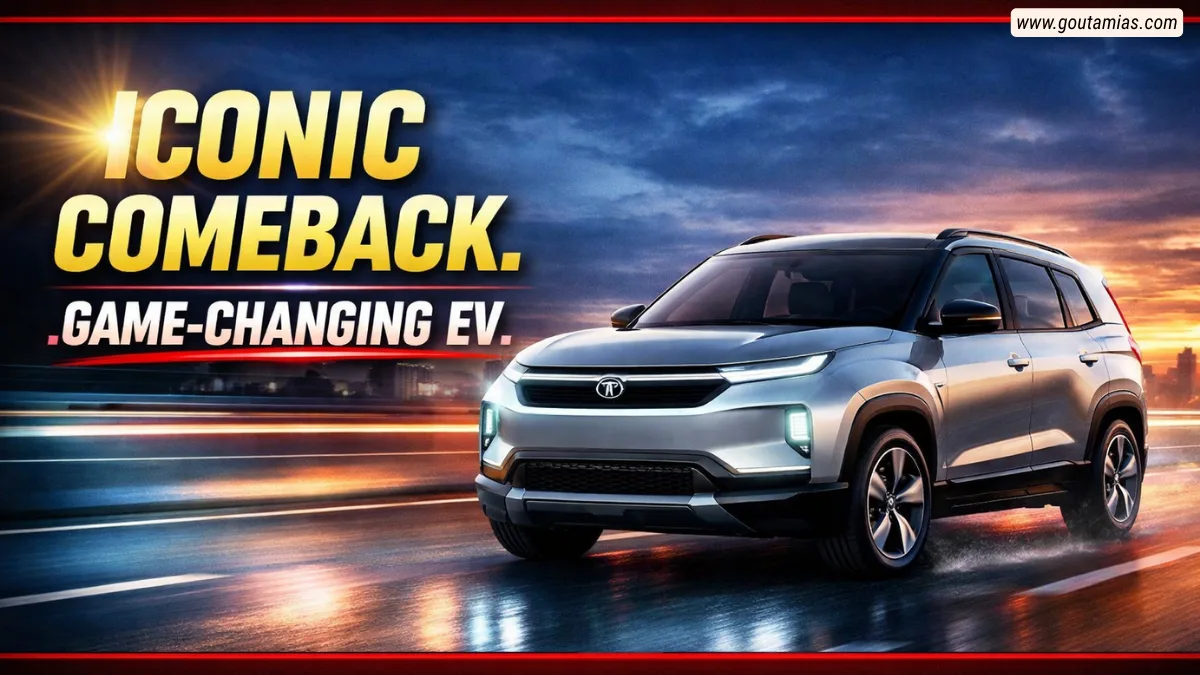

Tata Sierra EV is set to redefine India’s electric SUV segment as Tata Motors prepares for its highly anticipated May 2026 launch. This is not just another EV reveal—it marks the return of one of India’s most iconic nameplates in a completely modern, electric avatar. Positioned in the fast-growing mid-size SUV segment, the Sierra EV promises a compelling mix of nostalgia, futuristic design, advanced technology, and possibly a disruptive ownership model.
As India accelerates toward electrification in 2026, the Sierra EV enters the spotlight at a critical moment. With rivals like the upcoming Maruti e-Vitara gearing up, Tata’s new flagship EV could reshape buyer expectations around design, pricing, and ownership experience.
- A Legacy Reimagined for the Electric Era
- Cabin Experience: Premium, Digital, and Spacious
- Powertrain and Range: What to Expect
- Battery-as-a-Service (BaaS): A Potential Industry Disruptor
- Tata Sierra EV vs Maruti e-Vitara: The Upcoming Rivalry
- Why This Matters
- Future Impact and Market Outlook
- Conclusion
- FAQs
- 1. When will the Tata Sierra EV launch in India?
- 2. What will be the expected range of the Tata Sierra EV?
- 3. Will the Tata Sierra EV offer AWD?
- 4. What is Battery-as-a-Service (BaaS)?
- 5. Will the Sierra EV compete with Maruti e-Vitara?
- 6. What are the key features expected in the Sierra EV?
- 7. Is Tata Sierra EV based on a new platform?
A Legacy Reimagined for the Electric Era
The Tata Sierra name carries emotional weight for Indian buyers who remember its bold, unconventional design from the 1990s. The Sierra EV retains that spirit while evolving into a thoroughly modern SUV.
Expect a strong visual identity defined by:
- A signature upright stance inspired by the original Sierra
- Seamless LED light bars at the front and rear
- A closed-off EV grille with illuminated branding
- Aerodynamically optimized alloy wheels
- A reinterpretation of the iconic rear-quarter glass design
This design strategy does more than evoke nostalgia—it gives Tata a unique edge in a market where many EVs look increasingly similar.
Cabin Experience: Premium, Digital, and Spacious
Inside, the Sierra EV is expected to push Tata’s current design language to a new level. Built on a dedicated EV architecture, the cabin will likely offer more space and flexibility than traditional SUVs.
Key expected features include:
- Large floating touchscreen infotainment system
- Fully digital instrument cluster
- Panoramic sunroof
- Ventilated and powered front seats
- Multi-zone climate control
- Premium sustainable interior materials
Advanced Technology & Safety
The Sierra EV is also expected to feature a comprehensive ADAS suite, including:
- Adaptive cruise control
- Lane-keeping assist
- Blind-spot monitoring
- 360-degree camera
This positions it not just as an EV, but as a tech-forward family SUV designed for modern buyers.
Powertrain and Range: What to Expect
The Tata Sierra EV is likely to offer multiple battery configurations, catering to different driving needs and budgets.
Expected Specifications
| Feature | Expected Details |
|---|---|
| Battery Options | Two variants (standard & long-range) |
| Range | 400–500 km (estimated) |
| Drive Type | RWD and AWD options |
| Charging | Fast charging support |
| Performance | Instant torque, smooth acceleration |
The inclusion of both Rear-Wheel Drive and All-Wheel Drive options is a major highlight, giving Tata an advantage in performance versatility compared to many rivals.
Battery-as-a-Service (BaaS): A Potential Industry Disruptor
One of the most talked-about aspects of the Sierra EV is the possibility of a Battery-as-a-Service (BaaS) model.
What is BaaS?
Instead of buying the battery upfront, customers:
- Purchase the car without the battery
- Pay a monthly subscription for battery usage
Why It Matters
- Lower initial purchase cost
- Reduced concerns about battery degradation
- Easier upgrades and replacements
- Potential battery swapping convenience
If implemented successfully, BaaS could significantly accelerate EV adoption in India by addressing one of the biggest barriers: high upfront cost.
Tata Sierra EV vs Maruti e-Vitara: The Upcoming Rivalry
The Sierra EV will directly compete with the upcoming Maruti e-Vitara, setting up one of the most important EV battles in India.
Comparison Snapshot
| Factor | Tata Sierra EV | Maruti e-Vitara |
|---|---|---|
| Brand Strength | EV leader in India | ICE market dominance |
| Design | Iconic, futuristic | Likely conservative |
| Tech Features | High-end, ADAS-heavy | Practical, user-friendly |
| Ownership Model | Possible BaaS | Traditional |
| Driving Options | RWD + AWD | Likely FWD/AWD |
Tata’s advantage lies in its early EV ecosystem and innovation, while Maruti will rely on trust, pricing, and service reach.
Why This Matters
The Sierra EV is more than a new product—it represents a shift in India’s EV journey.
- It brings emotional design into the EV era
- It could redefine pricing with BaaS
- It strengthens Tata’s EV leadership
- It raises competition in the mid-size SUV segment
For consumers, this means better technology, more choices, and faster innovation.
Future Impact and Market Outlook
Looking ahead, the Sierra EV could:
- Set new benchmarks for EV design in India
- Push competitors to adopt flexible ownership models
- Expand EV adoption beyond early adopters
- Influence global perception of Indian EV innovation
If Tata delivers on expectations, the Sierra EV could become a category-defining vehicle.
Conclusion
The Tata Sierra EV stands at the intersection of legacy and innovation. With its bold design, advanced technology, flexible powertrain options, and the possibility of a revolutionary ownership model, it has all the ingredients to become a game-changer in India’s EV landscape.
As the May 2026 launch approaches, one thing is clear—the Sierra EV is not just coming back; it’s coming back to lead.
Click to Read More: Tata Sierra vs Toyota Urban Cruiser Hyryder 2026: Which SUV Should You Really Buy?
FAQs
1. When will the Tata Sierra EV launch in India?
The Tata Sierra EV is expected to launch in May 2026.
2. What will be the expected range of the Tata Sierra EV?
The expected range is around 400–500 km, depending on the battery variant.
3. Will the Tata Sierra EV offer AWD?
Yes, it is expected to offer both RWD and AWD configurations.
4. What is Battery-as-a-Service (BaaS)?
BaaS allows buyers to subscribe to the battery separately, reducing the car’s upfront cost.
5. Will the Sierra EV compete with Maruti e-Vitara?
Yes, it will be one of its primary rivals in the mid-size electric SUV segment.
6. What are the key features expected in the Sierra EV?
ADAS, panoramic sunroof, digital cockpit, premium interiors, and connected tech.
7. Is Tata Sierra EV based on a new platform?
Yes, it is expected to be built on a dedicated EV architecture.