
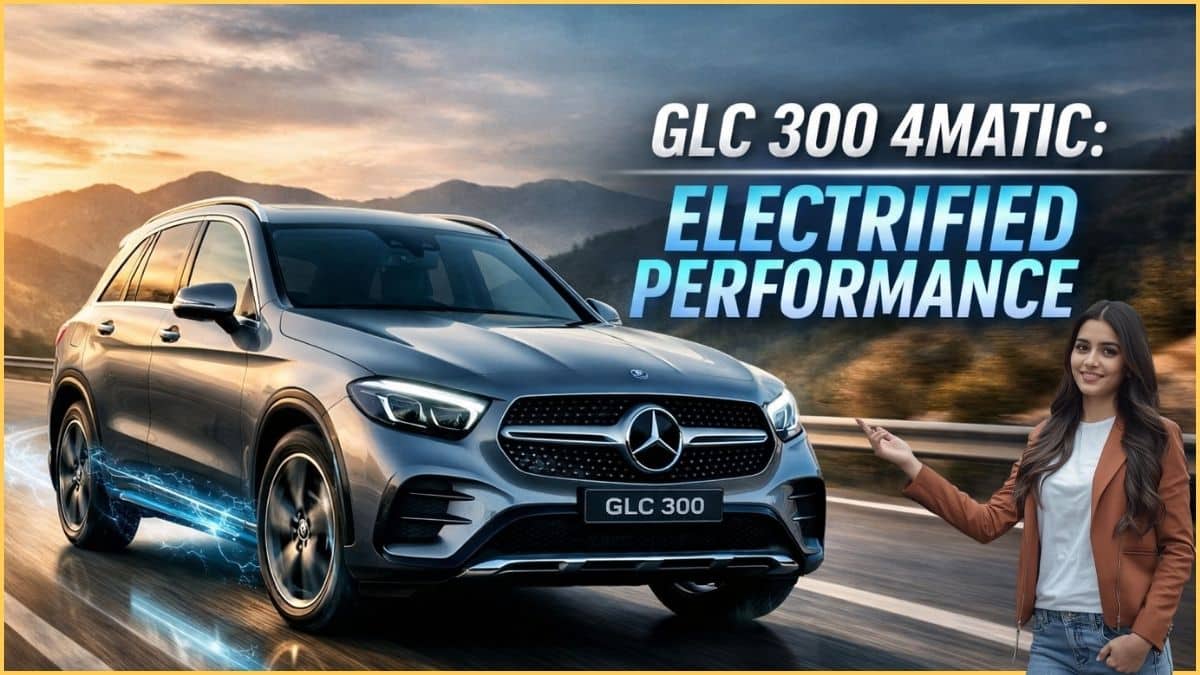

In a market racing toward electrification, the Mercedes-Benz GLC 300 4MATIC Powertrain stands out as a masterclass in intelligent evolution rather than radical disruption. Instead of abandoning combustion, Mercedes-Benz has refined it — adding electrified assistance, smarter torque management, and class-leading refinement to create a luxury SUV that feels both future-ready and emotionally satisfying.
For Indian buyers navigating rising fuel costs, tightening emission norms, and growing EV curiosity, this SUV offers a compelling middle ground. It delivers performance, efficiency, and everyday usability — without the compromises of range anxiety or charging infrastructure concerns.
So what makes this powertrain so strategically important in 2026? Let’s break it down.
- Mercedes-Benz GLC 300 4MATIC Powertrain Explained: Engine, Hybrid Tech & AWD Integration
- The Dynamic Core: 2.0-Litre Turbo-Petrol Engine
- 48V Mild-Hybrid System: The Silent Performance Booster
- 9G-TRONIC Transmission: Refinement as a Strategy
- 4MATIC AWD: More Than Just Traction
- How It Feels on the Road
- How It Compares: BMW X3 vs Audi Q5
- Why This Matters (India + Global Outlook)
- Interior & Technology: Supporting the Powertrain Philosophy
- Future Speculation: Is This the Last Step Before Full Hybrid?
- Conclusion: Intelligent Evolution Over Radical Disruption
- FAQs
- 1. Is the Mercedes-Benz GLC 300 4MATIC a full hybrid?
- 2. What is the power output of the GLC 300?
- 3. Does 4MATIC improve fuel efficiency?
- 4. Is the GLC 300 suitable for Indian road conditions?
- 5. How does it compare to the BMW X3?
- 6. Does the mild-hybrid system require charging?
- 7. What upgrades define the Mercedes-Benz GLC 300 4MATIC Powertrain?
- 8. Is the Mercedes-Benz GLC 300 4MATIC Powertrain good for Indian highways?
- 9. Does the Mercedes-Benz GLC 300 4MATIC Powertrain improve fuel efficiency?
- 10. Is the Mercedes-Benz GLC 300 4MATIC Powertrain future-ready?
Mercedes-Benz GLC 300 4MATIC Powertrain Explained: Engine, Hybrid Tech & AWD Integration
At its core, the GLC 300’s setup is a carefully engineered ecosystem — not just an engine with added tech.
Here’s how the components work together:
| Component | Specification | What It Means for You |
|---|---|---|
| Engine | 2.0L Turbo Petrol | Strong mid-range punch |
| Power Output | 258 hp | Quick overtakes, smooth highway cruising |
| Torque | 400 Nm | Effortless city drivability |
| Mild Hybrid Boost | +23 hp / +200 Nm | Instant acceleration assist |
| Gearbox | 9G-TRONIC 9-speed AT | Seamless, refined shifts |
| Drivetrain | 4MATIC AWD | All-weather confidence |
This isn’t just about numbers. It’s about integration.
The Dynamic Core: 2.0-Litre Turbo-Petrol Engine
Under the hood lies a refined 2.0-litre turbocharged four-cylinder petrol engine producing 258 hp and 400 Nm. In real-world conditions, that translates to:
Immediate throttle response
Strong mid-range acceleration
Confident highway overtakes
Smooth power delivery without drama
Unlike older turbo engines that suffered from lag, this unit feels linear and progressive — especially when combined with the mild-hybrid boost.
For Indian city traffic and open expressways alike, that wide torque band makes daily driving effortless.
48V Mild-Hybrid System: The Silent Performance Booster
The real headline feature in the Mercedes-Benz GLC 300 4MATIC Powertrain is the 48V mild-hybrid system with an integrated starter-generator (ISG).
Direct Answer:
The 48V mild-hybrid system adds 23 hp and 200 Nm of instant electric boost, improves fuel efficiency, enables smoother start-stop, and allows engine-off coasting.
What makes this important?
Eliminates turbo lag during initial acceleration
Enables near-imperceptible engine restart
Supports “gliding” at highway speeds
Recovers energy during braking
It’s not a full hybrid. It won’t drive purely on electricity. But it meaningfully enhances both responsiveness and efficiency — exactly what buyers in this segment want.
In India’s stop-start urban conditions, this tech makes a noticeable difference.
9G-TRONIC Transmission: Refinement as a Strategy
The 9-speed automatic gearbox deserves equal credit.
Nine ratios allow:
Lower RPM at cruising speeds
Faster downshifts when needed
Smoother transitions between gears
You don’t feel gear changes. You feel flow.
And in a luxury SUV priced at a premium, that seamlessness matters more than raw aggression.
4MATIC AWD: More Than Just Traction
Mercedes-Benz’s 4MATIC system continuously monitors wheel slip and redistributes torque proactively.
Direct Answer:
4MATIC improves stability, grip, and handling by sending power to the wheels with the most traction in real time.
For India:
Monsoon roads
Broken tarmac
Hill drives
Highway cornering stability
For global buyers:
Snow traction
Gravel confidence
Dynamic control at speed
It’s a system you don’t notice — until you need it.
How It Feels on the Road
All these systems converge into a driving character that feels:
Calm in traffic
Quick when provoked
Stable in corners
Efficient during cruises
0–100 km/h happens in around 6.2 seconds (approx), but what stands out is not the speed — it’s the composure.
This is performance without aggression. Power without noise. Acceleration without drama.
That’s classic Mercedes-Benz philosophy.
How It Compares: BMW X3 vs Audi Q5
In India, the key rivals include:
BMW X3
Audi Q5
BMW X3 feels sharper and sportier.
Audi Q5 focuses on refinement and Quattro grip.
The GLC 300 positions itself between them — offering:
Sportiness with smoothness
Electrification without complexity
Luxury without harsh suspension
Its mild-hybrid system is a differentiator in day-to-day refinement.
Why This Matters (India + Global Outlook)
The global luxury SUV market is at an inflection point.
Full EVs are growing. Hybrids are rising. But infrastructure gaps remain — especially in India.
The Mercedes-Benz GLC 300 4MATIC Powertrain represents a transitional sweet spot:
Lower emissions
Better fuel efficiency
No charging dependency
Enhanced responsiveness
For Indian professionals, business owners, and urban families, it offers future-aligned technology without lifestyle compromise.
Globally, it shows how combustion engines can still evolve intelligently.
Interior & Technology: Supporting the Powertrain Philosophy
Inside, the GLC complements its mechanical refinement with:
MBUX infotainment system
High-resolution digital displays
Voice assistant integration
Advanced driver assistance systems
The calm cabin mirrors the composed drivetrain. Even engine restarts are barely perceptible — a subtle reminder of how far mild-hybrid tech has come.
Future Speculation: Is This the Last Step Before Full Hybrid?
Mercedes-Benz is aggressively expanding its EQ lineup. Yet vehicles like the GLC 300 suggest something important:
Electrification is a journey — not a switch.
Expect:
Stronger hybrid integration
Plug-in variants expansion
Even smarter torque vectoring
But for 2026 buyers, this setup feels mature and balanced.
Conclusion: Intelligent Evolution Over Radical Disruption
The Mercedes-Benz GLC 300 4MATIC Powertrain isn’t revolutionary in the loudest sense — it’s revolutionary in refinement.
It combines:
Turbocharged strength
Electric assistance
Intelligent AWD
Seamless transmission
The result is a luxury SUV that feels future-ready without sacrificing traditional performance character.
For buyers who want electrified sophistication without EV uncertainty, this is one of the most balanced offerings in the segment.
Click to Read More: BMW X3 xDrive30i M Sport Pro: Why This Electrified SUV Is the Ultimate Driving Machine of 2026
FAQs
1. Is the Mercedes-Benz GLC 300 4MATIC a full hybrid?
No. It uses a 48V mild-hybrid system that assists the engine but cannot drive the car independently on electricity.
2. What is the power output of the GLC 300?
It produces 258 hp and 400 Nm, plus an additional 23 hp electric boost.
3. Does 4MATIC improve fuel efficiency?
Indirectly, yes. It optimizes traction and reduces unnecessary wheel slip, improving overall drivetrain efficiency.
4. Is the GLC 300 suitable for Indian road conditions?
Yes. Its AWD system, strong torque band, and refined suspension make it ideal for urban, highway, and monsoon conditions.
5. How does it compare to the BMW X3?
The X3 is sportier. The GLC focuses more on refinement and hybrid-enhanced smoothness.
6. Does the mild-hybrid system require charging?
No. It recharges automatically through regenerative braking.
7. What upgrades define the Mercedes-Benz GLC 300 4MATIC Powertrain?
The Mercedes-Benz GLC 300 4MATIC Powertrain adds a 48V mild-hybrid system for smoother acceleration, better efficiency, and refined start-stop performance compared to older versions.
8. Is the Mercedes-Benz GLC 300 4MATIC Powertrain good for Indian highways?
Yes. The Mercedes-Benz GLC 300 4MATIC Powertrain delivers strong mid-range torque, seamless 9-speed shifts, and stable 4MATIC grip for confident long-distance driving.
9. Does the Mercedes-Benz GLC 300 4MATIC Powertrain improve fuel efficiency?
The Mercedes-Benz GLC 300 4MATIC Powertrain enhances efficiency through regenerative braking, electric boost assist, and engine-off coasting.
10. Is the Mercedes-Benz GLC 300 4MATIC Powertrain future-ready?
Yes. The Mercedes-Benz GLC 300 4MATIC Powertrain aligns with stricter emission norms while offering electrified performance without EV charging dependency.




2 thoughts on “Mercedes-Benz GLC 300 4MATIC Powertrain: The 48V Mild-Hybrid Setup That Changes Luxury SUV Performance”