
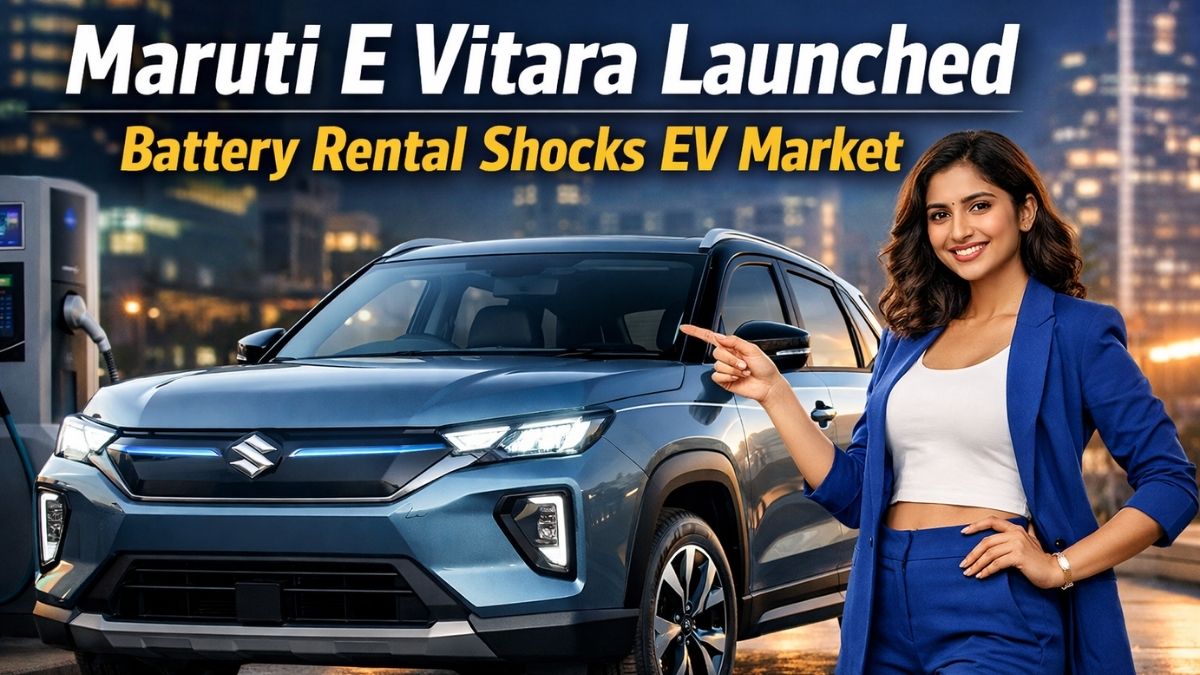

Maruti E Vitara launched in India, marking the automaker’s first serious entry into the mass-market electric SUV space in 2026. This launch matters now because India’s EV transition is accelerating, and Maruti Suzuki’s scale could reshape pricing, ownership models, and competition for urban families and fleet buyers alike.
With an innovative battery rental approach, assured buyback promise, and safety positioning aligned with Bharat NCAP expectations, this move directly impacts mid-size SUV buyers considering electric mobility but hesitant about long-term battery costs.
- A Strategic Electric Debut, Not Just Another EV
- Quick Snapshot: Maruti E Vitara at a Glance
- What Makes the Maruti E Vitara Different?
- Direct Answer: What is Maruti E Vitara’s battery rental model?
- Direct Answer: Who should consider the Maruti E Vitara?
- Competitive Context: Where It Stands in 2026
- Feature & Ownership Breakdown
- Why This Matters
- Market Implications
- What Happens Next: Future Impact
- Direct Answer: Is Maruti E Vitara suitable for long-term ownership?
- Expert Perspective: Strategic Timing
- Conclusion
- FAQs
A Strategic Electric Debut, Not Just Another EV
The Maruti E Vitara launched announcement is more than a product introduction. It represents a structural shift in how India’s largest carmaker is approaching electrification.
Unlike competitors that led with premium pricing, Maruti has introduced:
A battery-as-a-service (BaaS) ownership model
Assured buyback structure
Competitive entry pricing strategy
Safety-focused branding aligned with Bharat NCAP
This positions the E Vitara not merely as an EV, but as a lower-risk transition product for cautious Indian buyers.
Quick Snapshot: Maruti E Vitara at a Glance
| Category | Details |
|---|---|
| Segment | Mid-size Electric SUV |
| Ownership Model | Battery rental option available |
| Safety Focus | Bharat NCAP-oriented positioning |
| Platform | Dedicated EV architecture |
| Target Buyers | Urban SUV buyers, fleet operators, early EV adopters |
| Market Impact | Challenges Tata, Hyundai, MG EV portfolios |
What Makes the Maruti E Vitara Different?
1. Battery Rental Scheme (BaaS Model)
The biggest differentiator is the battery rental scheme.
Instead of paying the full battery cost upfront, buyers can:
Purchase the vehicle shell at a lower price
Pay a monthly battery subscription
Reduce initial ownership burden
This lowers the entry barrier — traditionally the biggest obstacle in EV adoption.
2. Assured Buyback
Maruti’s assured buyback strategy addresses resale anxiety, a critical concern in India’s EV market.
Battery degradation fears often impact resale value. A structured buyback program increases confidence and could improve fleet adoption.
3. Safety Positioning
Maruti has clearly aligned the E Vitara with Bharat NCAP safety expectations — a strong move in 2026 when safety ratings significantly influence buyer decisions.
Direct Answer: What is Maruti E Vitara’s battery rental model?
The Maruti E Vitara battery rental model allows buyers to purchase the vehicle at a lower upfront cost and subscribe to the battery separately through a monthly fee. This reduces initial purchase price and protects customers from long-term battery replacement risks.
Direct Answer: Who should consider the Maruti E Vitara?
Urban SUV buyers, daily commuters, and fleet operators who want lower upfront EV costs and structured resale assurance should consider the Maruti E Vitara. The battery subscription model makes it particularly attractive for high-mileage users.
Competitive Context: Where It Stands in 2026
India’s electric SUV space already includes:
Tata Motors with Nexon EV
MG Motor with ZS EV
Hyundai Motor India with Kona Electric
However, none of them aggressively introduced a large-scale battery rental strategy at this price point.
That gives Maruti a structural advantage — not just a product advantage.
Feature & Ownership Breakdown
| Feature | Maruti E Vitara | Typical EV Rival |
|---|---|---|
| Battery Purchase | Optional subscription | Full upfront |
| Resale Assurance | Assured buyback | Market-dependent |
| Brand Network | Massive nationwide | Limited compared to Maruti |
| Service Reach | Tier-2 & Tier-3 strong | Urban-focused |
This distribution advantage may prove decisive.
Why This Matters
India’s EV adoption is currently constrained by:
High upfront pricing
Battery longevity fears
Charging infrastructure concerns
Resale uncertainty
The Maruti E Vitara launched announcement directly tackles two of these: upfront pricing and resale confidence.
If successful, this model could:
Force competitors to rethink pricing
Expand EV penetration in smaller cities
Accelerate fleet electrification
Create a new ownership benchmark
This isn’t just another electric SUV — it’s a business model experiment at scale.
Market Implications
Maruti Suzuki has historically dominated through:
Value engineering
Wide dealer network
Trust-based resale ecosystem
By combining these with EV subscription economics, it may:
Normalize battery leasing
Trigger price corrections
Improve EV affordability perception
In 2026’s tightening regulatory climate and stronger emission targets, this timing is strategic.
What Happens Next: Future Impact
The next 12–24 months will determine whether:
Battery subscription becomes mainstream
Competitors replicate the model
Residual values remain stable
Tier-2 and Tier-3 markets adopt EVs faster
If adoption crosses critical volume thresholds, India could witness its most significant EV inflection point since the Nexon EV’s initial surge.
Expect:
Financing innovations
Corporate fleet deals
Government alignment with subscription frameworks
Charging partnerships expansion
This launch may redefine how electric vehicles are sold in India.
Direct Answer: Is Maruti E Vitara suitable for long-term ownership?
Yes. The battery rental structure reduces long-term battery replacement risks, and the assured buyback policy increases resale confidence. For cost-conscious Indian buyers, this improves overall ownership predictability compared to traditional EV models.
Expert Perspective: Strategic Timing
From an editorial standpoint, this move reflects strategic patience.
Maruti did not rush into the early EV wave. Instead, it waited for:
Charging network expansion
Policy clarity
Consumer maturity
Safety-driven buying trends
Now entering with a differentiated ownership model suggests calculated execution rather than reactive entry.
That is far more powerful.
Conclusion
The Maruti E Vitara launched event signals a transformational phase for India’s electric vehicle market. It blends affordability strategy, resale assurance, and safety positioning into one structured offering.
If executed effectively, this could shift EV buying psychology from hesitation to confidence.
India’s largest carmaker has finally entered the electric race — but on its own terms.
Click to Read More: Maruti Brezza Facelift 2026: Biggest Upgrade Yet with Hybrid Power & Premium Features




2 thoughts on “Maruti E Vitara Launched: Battery Rental EV That Could Transform India”