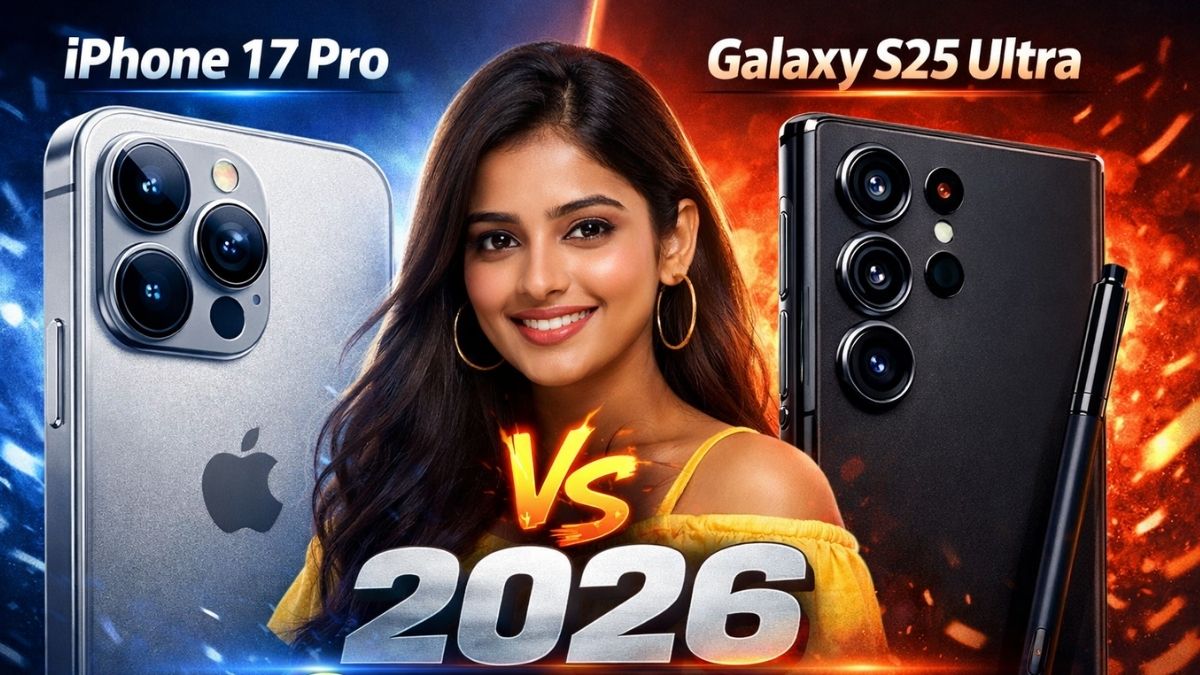

By 2026, the smartphone wars are no longer just about specs — they’re about which device fits your life. Here’s everything you need to know before spending over ₹1 lakh on your next phone.
This isn’t a comparison of two phones. It’s a comparison of two philosophies, two ecosystems, and two very different ideas of what a “smart” phone should actually do for you.
We break it all down — design, displays, performance, cameras, AI, battery, pricing, and real-world value — so you can make the right call.
- What Kind of Phone Buyer Are You?
- iPhone 17 Pro vs Samsung Galaxy S25 Ultra: Design and Build
- Display: Two Different Definitions of “Best Screen”
- Performance: Apple’s A19 vs Snapdragon 8 Gen 5
- Camera Systems: Computational Art vs Versatile Powerhouse
- AI Integration: Where 2026 Smartphones Actually Diverge
- Battery Life and Charging
- Pricing in India and Globally (Expected)
- Why This Matters: The 2026 Smartphone Is an AI Device First
- So, Which One Should You Buy?
- Conclusion
- FAQs
What Kind of Phone Buyer Are You?
Before diving into specs, ask yourself one question: are you already living inside Apple’s ecosystem — iPhone, MacBook, Apple Watch, AirPods — or are you a Windows user who values customization and flexibility?
Your honest answer to that question will decide 80% of your purchase. The remaining 20%? That’s where specs, cameras, and AI features genuinely matter. Let’s get into it.
iPhone 17 Pro vs Samsung Galaxy S25 Ultra: Design and Build
Apple is expected to continue refining the titanium frame introduced with the iPhone 15 Pro, potentially pairing it with a next-generation Ceramic Shield glass. The bigger change, however, could be structural: credible industry reports suggest the iPhone 17 Pro may finally go fully portless, ditching the Lightning/USB-C port entirely in favour of MagSafe-only connectivity. That’s a bold, polarising move — classic Apple.
The Galaxy S25 Ultra, on the other hand, doubles down on utility. Samsung’s design language for its Ultra series has always been about commanding presence — a large flat display, minimal camera bump, and the iconic built-in S Pen that no other flagship can match. Expect a titanium alloy or next-generation Armor Aluminum frame, with further refinements to how the camera module sits flush against the body.
Quick take: If sleek minimalism matters to you, the iPhone 17 Pro wins on design. If you want a device that feels like a mobile workstation, the S25 Ultra is in a league of its own.
Display: Two Different Definitions of “Best Screen”
iPhone 17 Pro Display
Apple’s ProMotion LTPO OLED panel with adaptive refresh up to 120Hz has been outstanding for two generations. In 2026, the headline upgrade is likely the arrival of a true under-display Face ID and front camera — no notch, no Dynamic Island, just an uninterrupted screen. Peak brightness will push beyond current limits, making outdoor use in harsh Indian sunlight significantly more comfortable.
Samsung Galaxy S25 Ultra Display
Samsung manufactures some of the best display panels on the planet — and they use their finest work on the Ultra. The S25 Ultra is expected to feature a Dynamic AMOLED 4.0 panel with deeper blacks, extraordinary colour volume, and an improved under-display selfie camera that’s nearly invisible. The large canvas (likely 6.9 inches) makes it exceptional for reading, note-taking with the S Pen, multitasking, and streaming.
| Feature | iPhone 17 Pro | Galaxy S25 Ultra |
|---|---|---|
| Panel Type | ProMotion LTPO OLED | Dynamic AMOLED 4.0 |
| Refresh Rate | Up to 120Hz | Up to 120Hz |
| Under-display Camera | Likely (first time) | Yes (improved) |
| S Pen Support | No | Yes |
| Display Size | ~6.3 inches | ~6.9 inches |
Performance: Apple’s A19 vs Snapdragon 8 Gen 5
Raw benchmark wars are largely irrelevant at this price point — both phones will handle anything you throw at them. The real difference is in how they handle it.
The A19 Bionic chip (Apple’s expected next-generation silicon) will be a marvel of hardware-software co-design. Apple writes its chip and its operating system in parallel, which means efficiency gains that Qualcomm-powered Android phones structurally can’t match. For tasks like video editing in Final Cut on your iPhone, ProRes recording, or machine learning inference for on-device AI, Apple’s Neural Engine remains the industry benchmark.
The Snapdragon 8 Gen 5 (or equivalent), built on a 2nm process node, will close that gap significantly. It will be an absolute powerhouse for gaming, multitasking across split-screen apps, and running Samsung’s Galaxy AI features at speed. For most users in most real-world scenarios, the performance difference will be invisible.
Camera Systems: Computational Art vs Versatile Powerhouse
iPhone 17 Pro Camera
Apple’s camera story in 2026 will centre on quality over quantity. Expect a larger main sensor with a possible variable aperture, a serious telephoto upgrade (potentially dual-periscope lenses), and further refinements to Apple’s already industry-leading video capabilities. ProRes, Cinematic Mode, and Spatial Video recording tailored for Apple Vision Pro make this the phone of choice for serious mobile videographers and content creators.
Samsung Galaxy S25 Ultra Camera
Samsung’s pitch is versatility. The S25 Ultra’s multi-sensor array — with its legendary Space Zoom system potentially reaching 100x hybrid zoom — gives photographers more creative options than any other smartphone on the market. Add in powerful generative AI editing tools baked directly into the Gallery app (erase objects, reframe compositions, enhance details), and you have a camera system designed for both casual shooters and photo enthusiasts who want full control.
Which camera wins? For video and consistent output: iPhone 17 Pro. For zoom range, flexibility, and AI editing: Galaxy S25 Ultra.
AI Integration: Where 2026 Smartphones Actually Diverge
This is the most consequential battleground of 2026 — and it’s where the two brands have fundamentally different approaches.
Apple Intelligence (iOS 19/20) will be privacy-first and deeply integrated. Siri will finally become genuinely useful — understanding context across apps, generating text, summarizing notifications, and managing your calendar intelligently. Crucially, Apple processes most AI tasks on-device, meaning your data rarely leaves your phone. For users in India and globally who are increasingly concerned about data privacy, this matters enormously.
Galaxy AI under One UI 8/9 is more aggressive and feature-rich out of the gate. Real-time call translation, generative AI for images and documents, intelligent S Pen note summarization, and Circle to Search integration make Samsung’s AI feel more immediately exciting. It’s more open, more experimental, and frankly more fun — but it leans on cloud processing more heavily.
Battery Life and Charging
The Galaxy S25 Ultra is expected to pack a 5,000mAh+ battery, and Samsung’s fast wired charging — likely 65W or above — remains faster than anything Apple offers. Wireless charging will also see improvements on both sides.
Apple will rely on efficiency gains from the A19 chip and iOS to deliver all-day battery life from a physically smaller cell. MagSafe wireless charging will be more refined, and reverse wireless charging for AirPods and Apple Watch is widely expected to become a standard feature on the Pro.
For power users who want the biggest battery and the fastest top-up: Samsung. For users who want smart battery management that just works all day: Apple.
Pricing in India and Globally (Expected)
| Model | Expected India Price | Expected US Price |
|---|---|---|
| iPhone 17 Pro (base) | ₹1,19,900 – ₹1,29,900 | $1,099 – $1,199 |
| Galaxy S25 Ultra (base) | ₹1,34,999 – ₹1,44,999 | $1,299 – $1,399 |
The Galaxy S25 Ultra is expected to command a higher starting price, reflecting its larger display, S Pen, and more expansive camera system. Both prices represent a significant investment, and buyers in India should factor in trade-in offers, bank cashback deals, and EMI options at launch.
Why This Matters: The 2026 Smartphone Is an AI Device First
Here’s the bigger picture: in 2026, your smartphone is no longer just a communication device. It’s your AI assistant, your creative studio, your productivity hub, and increasingly — through AR integrations — a window into spatial computing. The iPhone 17 Pro and Galaxy S25 Ultra are the first generation of devices built with that future as a first-order design priority, not an afterthought.
For Indian consumers specifically, where smartphone penetration continues to surge and mid-to-premium upgrades are accelerating, the choice between these two will define digital experiences for the next 3–4 years. That makes getting this decision right genuinely important.
So, Which One Should You Buy?
Choose the iPhone 17 Pro if: You’re already using Apple devices, you priorities video quality and privacy, and you want a device that ages gracefully with long-term software support and strong resale value in India.
Choose the Samsung Galaxy S25 Ultra if: You want maximum versatility, you use a stylus for work or creativity, you value the most flexible camera system available, and you prefer Android’s openness and customization.
There is no wrong answer here — only the wrong answer for you.
Conclusion
The iPhone 17 Pro vs Samsung Galaxy S25 Ultra debate in 2026 isn’t about which phone is objectively better. Both will be extraordinary machines. It’s about which vision of mobile computing aligns with how you actually live and work. Apple’s tight, private, optimised ecosystem vs Samsung’s expansive, powerful, and highly customisable platform. Choose your philosophy, then choose your phone.
Click to Find More: Nothing Phone 4a India Launch: Price, Specs & Sale Date 2026
FAQs
Q1. What is the core difference in iPhone 17 Pro vs Samsung Galaxy S25 Ultra? iPhone 17 Pro vs Samsung Galaxy S25 Ultra is a battle of ecosystems — Apple wins on privacy, video, and integration; Samsung wins on display size, S Pen, and AI feature variety.
Q2. Which camera is better in iPhone 17 Pro vs Samsung Galaxy S25 Ultra? iPhone 17 Pro leads on video and consistency. Galaxy S25 Ultra dominates zoom and AI editing. iPhone 17 Pro vs Samsung Galaxy S25 Ultra camera winner depends entirely on your shooting style.
Q3. What is the India price difference in iPhone 17 Pro vs Samsung Galaxy S25 Ultra? iPhone 17 Pro expected at ₹1,19,900; Galaxy S25 Ultra at ₹1,34,999. In the iPhone 17 Pro vs Samsung Galaxy S25 Ultra price battle, Apple starts cheaper.
Q4. Which has better AI — iPhone 17 Pro vs Samsung Galaxy S25 Ultra? Samsung Galaxy AI offers more visible features. Apple Intelligence prioritises on-device privacy. In iPhone 17 Pro vs Samsung Galaxy S25 Ultra, better AI depends on whether you want features or security.
Q5. Which phone lasts longer software-wise in iPhone 17 Pro vs Samsung Galaxy S25 Ultra? Samsung guarantees 7 years of updates; Apple offers 5–6 years. In iPhone 17 Pro vs Samsung Galaxy S25 Ultra, Samsung edges ahead on software longevity.
Q6. Is S Pen a dealbreaker in iPhone 17 Pro vs Samsung Galaxy S25 Ultra? For stylus users — absolutely yes. iPhone 17 Pro vs Samsung Galaxy S25 Ultra is no contest here; Galaxy S25 Ultra wins for creators and note-takers.
Q7. Which is faster — iPhone 17 Pro vs Samsung Galaxy S25 Ultra? A19 Bionic edges Snapdragon 8 Gen 5 on efficiency and sustained performance. In iPhone 17 Pro vs Samsung Galaxy S25 Ultra, Apple’s chip-OS integration remains the benchmark.
Q8. Which charges faster in iPhone 17 Pro vs Samsung Galaxy S25 Ultra? Samsung charges faster with 65W+ wired speeds. Apple prioritises battery health over speed. In iPhone 17 Pro vs Samsung Galaxy S25 Ultra charging comparison, Samsung wins on raw speed.
Q9. Which is better for Indian buyers — iPhone 17 Pro vs Samsung Galaxy S25 Ultra? Apple suits ecosystem users with better resale value. Samsung suits Android loyalists wanting versatility. iPhone 17 Pro vs Samsung Galaxy S25 Ultra — both are strong; your ecosystem decides.
Q10. Should you upgrade to iPhone 17 Pro vs Samsung Galaxy S25 Ultra in 2026? If your phone is 3+ years old, yes — absolutely. iPhone 17 Pro vs Samsung Galaxy S25 Ultra both deliver generational leaps in AI, camera, and display worth every rupee.