
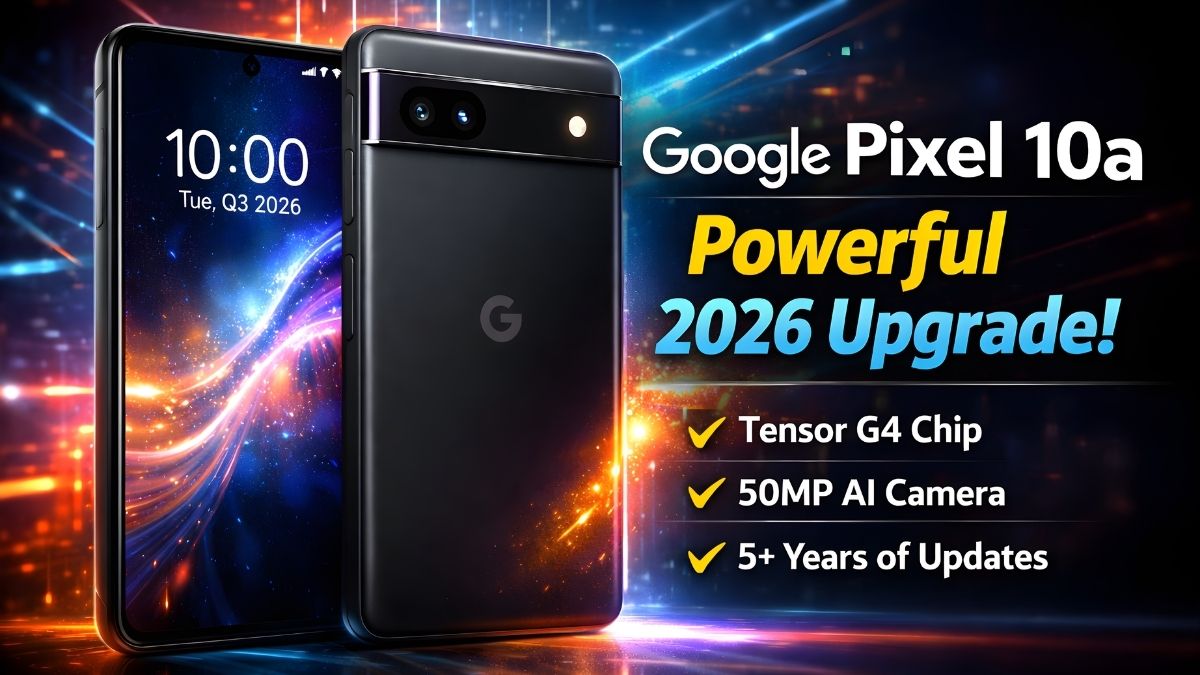

- Introduction
- Google Pixel 10a: Expected Specifications at a Glance
- Why Google Is Betting Big on the Mid-Range Segment in 2026
- Display and Design: A More Premium Feel?
- Performance: Tensor G4 Could Change the Game
- Camera: Still the King of Computational Photography?
- Battery and Charging: A Practical Upgrade
- Software & Updates: A Major Differentiator
- Competitive Landscape in 2026
- Why This Matters
- What Happens Next: Future Impact
- Conclusion
- FAQs
- 1. What is the Google Pixel 10a?
- 2. When will the Google Pixel 10a launch?
- 3. What processor will the Google Pixel 10a use?
- 4. What are the expected camera specifications of the Google Pixel 10a?
- 5. Will the Google Pixel 10a have a 120Hz display?
- 6. What battery capacity is expected in the Google Pixel 10a?
- 7. How many years of updates will the Google Pixel 10a receive?
- 8. What could be the price of the Google Pixel 10a in India?
Introduction
Google Pixel 10a is Google’s upcoming mid-range smartphone expected to launch in 2026, and it matters right now because the global mid-premium segment is witnessing its fastest growth in five years. With competition intensifying from Samsung, Xiaomi, and OnePlus, this device could redefine what buyers expect under the ₹45,000 / $500 category.
For everyday users, creators, and budget-conscious premium buyers, the Pixel 10a may represent the most balanced Android experience of the year — blending AI, camera intelligence, and clean software in a segment that is rapidly shifting toward performance and long-term updates.
Google Pixel 10a: Expected Specifications at a Glance
While official details are still under wraps, early supply-chain indicators and industry leaks suggest a meaningful upgrade cycle.
| Feature | Expected Specification |
|---|---|
| Processor | Tensor G4 (refined AI core) |
| Display | 6.1-inch OLED, 120Hz |
| Camera | 50MP primary + AI enhancements |
| Battery | 4,500–4,700mAh |
| Charging | 27W wired |
| Software | Android 16 |
| Updates | 5+ years security support |
| Expected Launch | Q3 2026 |
If these projections hold true, the Pixel 10a would close the performance gap between flagship Pixels and the A-series more than ever before.
Why Google Is Betting Big on the Mid-Range Segment in 2026
The global smartphone market is stabilizing after two volatile years. However, the ₹30,000–₹50,000 category has seen double-digit growth in India, Southeast Asia, and parts of Europe.
Consumers are no longer chasing pure hardware specs. Instead, they want:
Long-term software support
AI-powered camera tools
Reliable performance
Clean Android experience
This is where Google’s strategy becomes sharp.
The Pixel A-series has consistently delivered premium camera output at mid-range pricing. In 2026, that advantage is even more critical as AI-based photography and on-device processing become mainstream.
Display and Design: A More Premium Feel?
Industry analysts expect Google to introduce slimmer bezels and a smoother 120Hz refresh rate — a first for the A-series at launch parity.
If Google upgrades brightness levels beyond 1,500 nits peak, it would address one of the biggest complaints from previous generations.
Design-wise, Google is likely to retain the iconic camera bar — now a recognizable Pixel signature — but may reduce weight and improve durability with Gorilla Glass Victus protection.
This refinement could position the Pixel 10a closer to flagship territory visually, without inflating the price.
Performance: Tensor G4 Could Change the Game
The biggest upgrade may come from the processor.
If the Pixel 10a uses the Tensor G4 — even a slightly binned version — users can expect:
Improved AI processing
Better battery optimization
Enhanced speech recognition
Stronger on-device generative AI tools
Unlike competitors that rely purely on benchmark performance, Google focuses on intelligent optimization.
That means smoother real-world performance rather than just high AnTuTu scores.
Camera: Still the King of Computational Photography?
Google’s strength has always been computational photography.
Direct Answer (Snippet Optimized)
The Google Pixel 10a is expected to feature a 50MP primary sensor powered by Google’s advanced AI image processing, enabling superior low-light shots, natural skin tones, and improved HDR performance compared to most mid-range competitors.
Even if hardware remains similar to previous models, AI tuning could make a dramatic difference.
Features likely to expand:
Magic Editor enhancements
Real-time video HDR
Improved Night Sight
AI zoom stabilization
In a segment crowded with 64MP and 108MP sensors, Google’s software advantage still stands out.
Battery and Charging: A Practical Upgrade
Direct Answer (Snippet Optimized)
The Google Pixel 10a may include a battery around 4,500–4,700mAh with optimized Tensor efficiency, potentially delivering all-day usage even with a 120Hz display enabled.
While 27W charging won’t break speed records, Google typically prioritizes battery longevity over extreme fast-charging.
For long-term users, that approach could improve device lifespan.
Software & Updates: A Major Differentiator
One of the strongest selling points:
Direct Answer (Snippet Optimized)
The Google Pixel 10a is expected to ship with Android 16 and offer at least five years of security updates, making it one of the most future-proof devices in the mid-range category.
This matters significantly in markets like India, where users now hold phones for 3–4 years on average.
Competitors rarely match Google’s update consistency at this price.
Competitive Landscape in 2026
Here’s how it could compare:
| Feature | Pixel 10a | Galaxy A-Series | OnePlus Nord |
|---|---|---|---|
| Software Updates | 5+ years | 3–4 years | 3 years |
| Camera Processing | AI-driven | Balanced | Hardware-focused |
| Clean UI | Stock Android | One UI | OxygenOS |
| AI Tools | Native Tensor AI | Limited | Limited |
If pricing remains aggressive, the Pixel 10a could dominate among users who prioritize camera and software over gaming-heavy performance.
Why This Matters
The mid-range category is no longer “budget.” It is now the mainstream choice.
If Google executes pricing strategically, the Pixel 10a could:
Increase Pixel market share in India
Push competitors to improve update policies
Normalize AI features in mid-tier phones
Strengthen Google’s ecosystem lock-in
More importantly, it signals a broader shift — where AI and software longevity become more important than raw hardware numbers.
What Happens Next: Future Impact
Looking ahead, 2026–2027 may mark a turning point.
If the Pixel 10a integrates deeper on-device AI — such as offline generative tools, smarter call screening, or AI-based photo enhancement — it could influence the entire Android ecosystem.
We may see:
Longer update commitments across brands
More Tensor-like AI chips
Software-first marketing strategies
The real question is pricing.
If Google keeps it under ₹45,000 in India, it becomes a category disruptor. If it creeps higher, it risks losing its A-series identity.
Conclusion
The Google Pixel 10a represents more than just another mid-range phone. It reflects the evolution of smartphones from hardware-focused devices to AI-powered daily companions.
In a market saturated with spec-heavy launches, Google’s strategy appears focused, intelligent, and long-term.
If the company balances pricing, AI innovation, and battery improvements, the Pixel 10a could quietly become one of the smartest smartphone purchases of 2026.
Click to Find More: Ducati Formula 73: The Ultimate Modern Classic That Could Become Ducati’s Most Valuable Collector Bike
FAQs
1. What is the Google Pixel 10a?
The Google Pixel 10a is Google’s upcoming mid-range smartphone expected in 2026, positioned to deliver flagship-level AI features, strong camera performance, and long-term Android updates at a more accessible price point.
2. When will the Google Pixel 10a launch?
The Google Pixel 10a is likely to launch in Q3 2026, following Google’s typical annual hardware release cycle, although the exact date has not been officially confirmed.
3. What processor will the Google Pixel 10a use?
The Google Pixel 10a is expected to feature the Tensor G4 chipset, enabling improved AI processing, better battery optimization, enhanced voice recognition, and smarter on-device features.
4. What are the expected camera specifications of the Google Pixel 10a?
The Google Pixel 10a may include a 50MP primary sensor supported by advanced computational photography, delivering strong low-light performance, accurate colors, and enhanced HDR capabilities.
5. Will the Google Pixel 10a have a 120Hz display?
Reports suggest the Google Pixel 10a could adopt a 120Hz OLED display, offering smoother scrolling and improved visual fluidity compared to previous A-series models.
6. What battery capacity is expected in the Google Pixel 10a?
The Google Pixel 10a is rumored to feature a battery between 4,500mAh and 4,700mAh, optimized for all-day usage with efficient power management.
7. How many years of updates will the Google Pixel 10a receive?
The Google Pixel 10a is expected to receive up to five years of security updates, making it one of the most future-ready devices in its price segment.
8. What could be the price of the Google Pixel 10a in India?
The Google Pixel 10a is projected to be priced between ₹40,000 and ₹45,000 in India, depending on storage configuration and launch offers.




2 thoughts on “Google Pixel 10a: The Breakthrough Mid-Range Upgrade of 2026”