
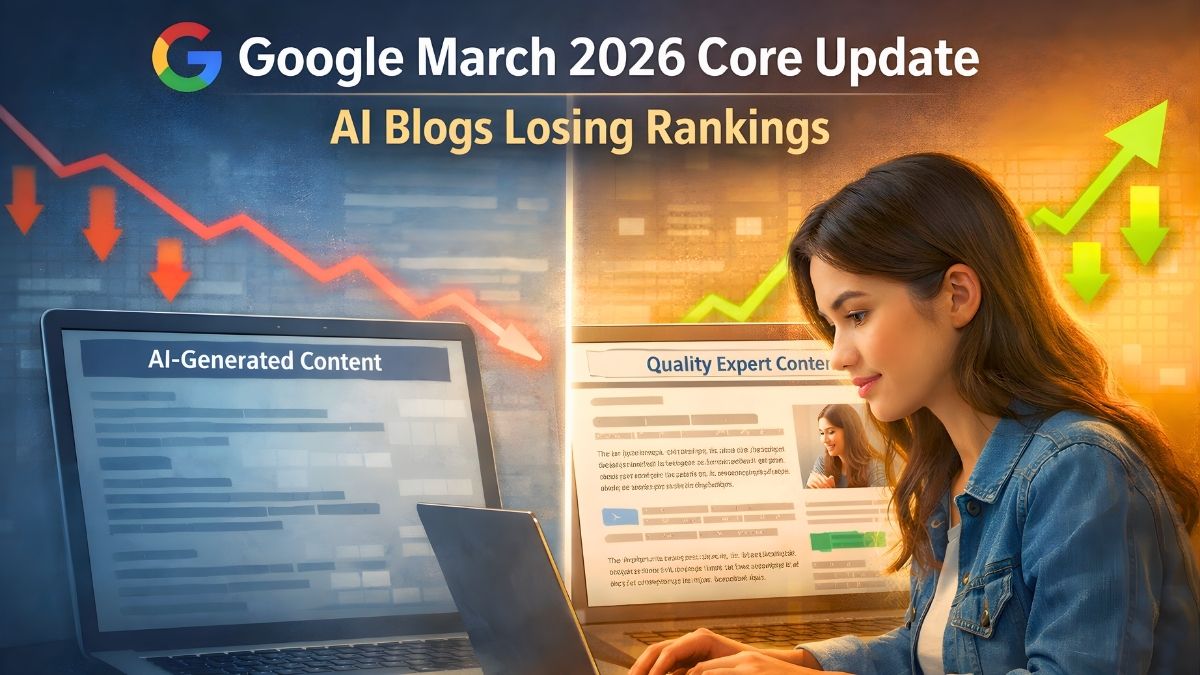

Google’s March 2026 Core Update is quietly reshaping search results — and early signals suggest that blogs built heavily on AI-generated content are among the biggest casualties.
The update began rolling out globally in early March 2026, and while Google hasn’t officially framed it as an “AI crackdown,” traffic drops across tech, affiliate, and niche content sites tell a different story.
For publishers, bloggers, and media startups — especially those relying on automated writing tools — this update could determine whether their content continues ranking or quietly disappears from Google Discover and Search.
- What the Google March 2026 Core Update Actually Targets
- Why AI-Heavy Blogs Are Seeing Traffic Drops
- A Real-World Example: The Affiliate Blog Problem
- Signals Google Appears to Be Rewarding Now
- Why Discover Traffic Is Particularly Affected
- The Market Context: AI Content Exploded Too Fast
- What Bloggers and Publishers Should Do Now
- Why Some AI-Powered Sites Are Still Thriving
- The Bigger Trend: Search Is Moving Toward Authority
- Final Thoughts: The Quiet End of Mass-Produced Content
- FAQs
- What is the Google March 2026 Core Update?
- Is the Google March 2026 Core Update targeting AI-generated content?
- Why are AI-heavy blogs losing traffic after the Google March 2026 Core Update?
- How can bloggers recover from the Google March 2026 Core Update?
- Does the Google March 2026 Core Update affect Google Discover traffic?
- How long does the Google March 2026 Core Update rollout take?
What the Google March 2026 Core Update Actually Targets
The Google March 2026 Core Update appears to tighten the algorithm’s ability to evaluate content originality, editorial oversight, and expertise signals — areas where many AI-heavy blogs struggle.
In practice, the update isn’t penalizing AI itself. Instead, it’s downgrading content that feels mass-produced, shallow, or editorially thin.
Google’s ranking systems now appear more sensitive to signals like:
Author credibility and expertise
First-hand experience or analysis
Unique data or perspective
Content freshness and updates
Reader engagement signals
That’s where things shift.
Over the last two years, thousands of blogs scaled content production using AI tools. Many pushed out hundreds of articles weekly — often rewriting news or summarizing existing content.
The new algorithm update seems to detect that pattern more aggressively.
Quick Answer: What Is the Google March 2026 Core Update?
The Google March 2026 Core Update is a broad search algorithm change designed to improve content quality and relevance. Early industry data suggests it prioritizes expert-driven, original content while reducing visibility for mass-produced AI-heavy articles with limited editorial input or unique insight.
Why AI-Heavy Blogs Are Seeing Traffic Drops
SEO tracking tools and publisher forums began noticing ranking volatility within days of the rollout.
Sites most affected typically share three patterns:
High publishing volume with minimal editorial oversight
Articles built primarily from aggregated information
Low author credibility signals
In other words, the update targets content farms — even modern AI-powered ones.
But context matters.
AI-assisted writing itself isn’t the problem. Many major publishers — including tech outlets and research firms — use AI tools in their workflow. The difference is editorial depth and expertise.
If a human editor adds analysis, experience, and structure, the content still signals value.
Without that? Rankings suffer.
A Real-World Example: The Affiliate Blog Problem
Consider a small affiliate tech blog covering smartphones.
Before the update, the owner might publish 50–70 AI-generated product reviews per week — mostly rewriting specs and summarizing launch announcements.
Traffic looked strong because Google still indexed and ranked those pages.
But after the Google March 2026 Core Update, several things happen:
Product pages drop from page 1 to page 3 or 4
Discover traffic disappears
New content takes longer to index
Meanwhile, fewer but deeply researched articles from trusted sites gain visibility.
For an Indian reader researching a phone upgrade — say a Delhi buyer comparing mid-range Android devices — Google’s updated ranking system now prioritizes hands-on reviews and expert commentary, not automated summaries.
That’s a significant shift.
Signals Google Appears to Be Rewarding Now
Across early SEO case studies, several patterns are emerging.
Sites that maintained or improved rankings tend to include stronger editorial signals.
Content Signals That Seem to Help
Original analysis or opinion
Author bios with expertise
First-hand product testing
Industry context beyond specs
Updated articles reflecting recent changes
This aligns with Google’s long-standing E-E-A-T framework — Experience, Expertise, Authoritativeness, and Trustworthiness.
But the algorithm appears far better at detecting the absence of those signals.
Quick Answer: Is Google Penalizing AI Content?
Google is not directly penalizing AI-generated content. Instead, the algorithm evaluates whether a page provides original value, expertise, and helpful information. If AI-generated text lacks editorial depth or unique insights, it’s more likely to lose rankings under the March 2026 Core Update.
Why Discover Traffic Is Particularly Affected
One overlooked impact of the Google March 2026 Core Update involves Google Discover, which drives massive traffic for news and tech blogs.
Discover heavily favors:
Authority signals
Fresh reporting
High reader engagement
AI-heavy blogs often struggle here because their content tends to mirror what’s already published elsewhere.
Without a strong editorial voice, Discover’s algorithm simply ignores those articles.
That’s why many publishers are reporting a sudden Discover traffic collapse rather than just small ranking fluctuations.
The Market Context: AI Content Exploded Too Fast
This update didn’t arrive randomly.
Between 2023 and 2025, generative AI tools dramatically lowered the cost of publishing online content. A single creator could produce hundreds of articles per month.
Some niche sites even scaled to tens of thousands of pages annually.
From Google’s perspective, that created a quality problem:
Search results began filling with repackaged information instead of original reporting or expertise.
So the Google March 2026 Core Update appears to be the company’s attempt to restore balance.
Not by banning AI — but by rewarding editorial value over production volume.
What Bloggers and Publishers Should Do Now
If your site relies heavily on automated content, the solution isn’t panic — it’s restructuring your editorial process.
Here’s what many successful publishers are shifting toward.
Steps to Protect Rankings After the Update
Add human editorial layers
AI can assist writing, but human editing must add insight, context, and clarity.Show real expertise
Include author bios, credentials, or real-world experience.Create deeper articles
Replace 500-word summaries with full analysis or real examples.Update older content
Fresh updates signal active editorial oversight.Focus on fewer but stronger articles
Quality now beats volume more than ever.
These steps align with Google’s broader push toward helpful, people-first content.
Why Some AI-Powered Sites Are Still Thriving
Interestingly, not every AI-assisted blog is struggling.
Several tech publishers that combine AI drafting with human expertise are still performing well.
Their workflow often looks like this:
AI assists with research summaries
Editors restructure and add analysis
Writers include real-world use cases
Experts review technical accuracy
The result feels human-led rather than machine-generated.
And that difference matters more than ever in 2026.
Quick Answer: How Can a Blog Survive the Google March 2026 Core Update?
To survive the Google March 2026 Core Update, blogs should focus on original insights, expert authorship, and deeper editorial analysis. AI tools can still assist writing, but content must demonstrate real expertise, human editing, and meaningful value beyond basic information summaries.
The Bigger Trend: Search Is Moving Toward Authority
There’s a broader shift happening across Google Search.
AI answers, knowledge panels, and algorithmic improvements are reducing the need for simple informational pages.
That means thin content has fewer opportunities to rank.
Instead, Google increasingly rewards:
Expert voices
Unique insights
First-hand experience
Strong brand authority
In short, the future of search belongs to publishers who contribute knowledge — not just text.
Final Thoughts: The Quiet End of Mass-Produced Content
The Google March 2026 Core Update may not be flashy, but its long-term impact could be massive.
For years, scaling content production was the fastest path to SEO growth. That strategy is now losing effectiveness.
Going forward, publishers will likely succeed by focusing on depth, expertise, and real editorial value.
And ironically, that might bring online publishing closer to traditional journalism again — fewer articles, better reporting, and stronger voices.
For bloggers and media startups, the message is clear:
AI can accelerate writing.
But in Google’s 2026 search ecosystem, expertise still wins the ranking battle.
Click to Read More: AI Agents in 2026: The Silent Tech That’s About to Replace Every App on Your Phone
FAQs
What is the Google March 2026 Core Update?
The Google March 2026 Core Update is a major search algorithm change aimed at improving the quality and relevance of search results. Early analysis suggests it prioritizes expert-driven, original content while reducing visibility for thin or mass-produced AI-heavy articles that lack editorial insight.
Is the Google March 2026 Core Update targeting AI-generated content?
No, the Google March 2026 Core Update is not directly penalizing AI-generated content. Google’s ranking systems focus on content quality, expertise, and usefulness. AI-written articles that lack original insight, human editing, or real expertise are more likely to lose rankings.
Why are AI-heavy blogs losing traffic after the Google March 2026 Core Update?
Many AI-heavy blogs rely on high-volume content that summarizes existing information rather than providing unique value. The Google March 2026 Core Update appears to detect these patterns more effectively, prioritizing content with stronger editorial signals, expert authorship, and real-world insights.
How can bloggers recover from the Google March 2026 Core Update?
To recover from the Google March 2026 Core Update, bloggers should focus on improving content quality by adding expert analysis, updating older articles, strengthening author credibility, and reducing reliance on purely AI-generated text. Human editing and original insights are becoming critical ranking signals.
Does the Google March 2026 Core Update affect Google Discover traffic?
Yes, the Google March 2026 Core Update appears to impact Google Discover visibility as well. Discover tends to favor authoritative publishers and fresh reporting. Blogs that publish large volumes of automated or repetitive content may see Discover traffic drop significantly.
How long does the Google March 2026 Core Update rollout take?
Like most major algorithm changes, the Google March 2026 Core Update typically rolls out over one to two weeks globally. During this period, search rankings may fluctuate significantly as Google recalibrates its ranking systems across different industries and content categories.