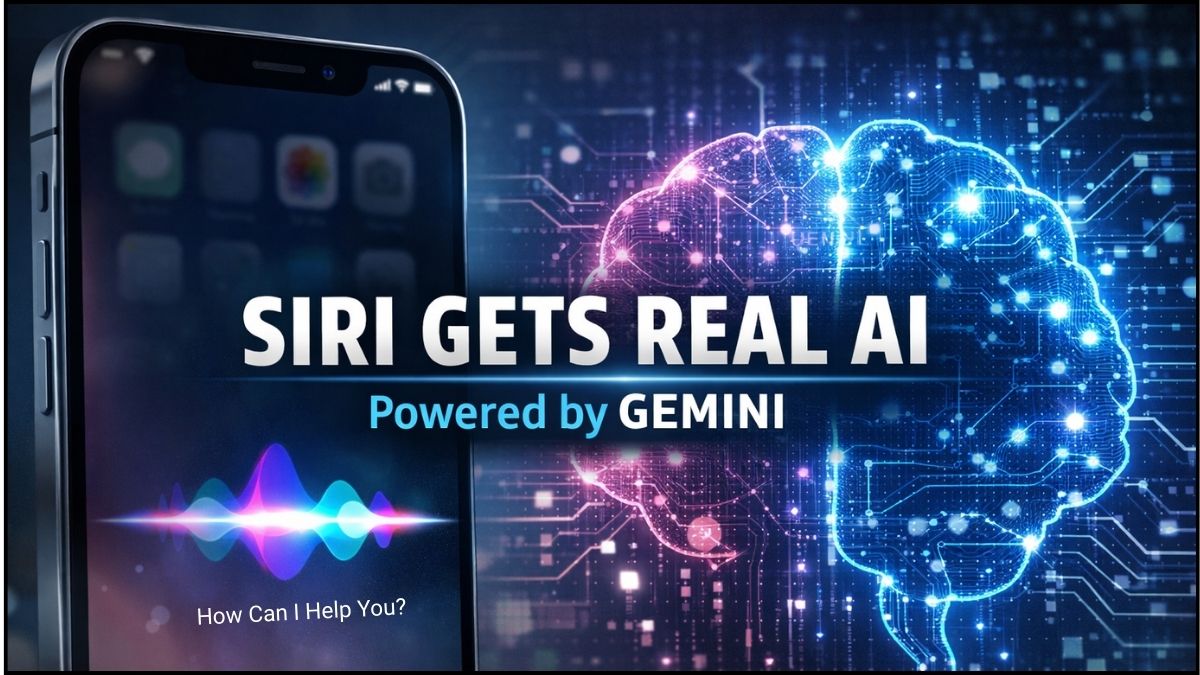

Apple’s voice assistant has spent over a decade playing catch-up. But Apple Siri 2026 AI upgrade changes that equation dramatically. In 2026, Apple is reportedly transforming Siri into a true AI assistant — and the engine behind that intelligence may surprise you: Google’s Gemini model.
If the reports hold true, this could be one of the most unusual alliances in modern tech: Apple’s privacy-first ecosystem powered by a core AI capability from its biggest competitor.
And for millions of iPhone users — including a growing base in India — it might finally mean Siri becomes genuinely useful.
- Apple Siri 2026 AI Upgrade: What Actually Changed?
- How It Stacks Up: Siri 2026 vs. Google Assistant vs. Samsung Galaxy AI
- Why Apple Is Using Google Gemini
- What the New AI Siri Can Actually Do
- Real-World Impact for iPhone Users
- Apple’s AI Strategy: Privacy Still Comes First
- The Competitive Context: Apple Is Late to AI
- The Developer Angle: AI Apps Are About to Change
- The Risks Apple Must Manage
- Why This Matters for the Future of Smartphones
- Conclusion
- FAQs
Apple Siri 2026 AI Upgrade: What Actually Changed?
For years, Siri functioned more like a command interpreter than a conversational AI. Ask a complex question and it often defaulted to a web search.
The Apple Siri 2026 AI upgrade changes that by integrating large language model capabilities similar to modern AI chat systems.
Instead of simple voice commands, Siri can now:
Hold multi-step conversations
Understand contextual follow-ups
Summarize messages, emails, and documents
Execute complex app actions across the iPhone ecosystem
Generate responses rather than just fetch results
In short, Siri moves from voice command tool → intelligent AI assistant.
That shift mirrors what users already expect from tools like ChatGPT or Gemini.
But Apple’s implementation is different — and strategic.
How It Stacks Up: Siri 2026 vs. Google Assistant vs. Samsung Galaxy AI
| Feature | Apple Siri 2026 | Google Assistant (Android) | Samsung Galaxy AI |
|---|---|---|---|
| LLM Backend | Google Gemini | Gemini (via Google) | Google Gemini + on-device |
| On-Device Processing | Yes (Apple Intelligence) | Limited | Yes (Snapdragon NPU) |
| App-Level Integration | Deep (iOS native) | Android-native | Galaxy apps only |
| Privacy Architecture | Hybrid (on-device first) | Cloud-primary | Hybrid |
| Cross-App Actions | Yes (confirmed) | Partial | Limited |
| Multilingual Support | Expected (via Gemini) | Strong | Moderate |
| Platform Lock-in | iOS / macOS only | Android | Galaxy devices only |
The table tells one interesting story: Google is effectively powering both its own assistant and now Apple’s. That’s a remarkable position for any AI company, and it means Gemini’s reach in 2026 will be unlike any LLM that came before it.
Why Apple Is Using Google Gemini
The biggest twist in this story is the underlying technology.
Reports suggest Apple is leaning on Google’s Gemini AI models to power some of Siri’s advanced reasoning capabilities. Apple still runs its own AI models on-device, but for complex tasks, Gemini may act as the backend engine.
The logic behind the partnership
Apple gets state-of-the-art AI performance immediately
Google expands Gemini’s reach to over a billion iPhones
Apple maintains control over privacy layers and device integration
That’s important because Apple has historically prioritized on-device AI processing.
In practice, the system likely works like this:
Simple tasks run locally on Apple’s neural engine
Complex queries are routed to cloud AI models
Responses return to Siri with Apple’s privacy filters
From a product standpoint, it’s pragmatic. Building competitive AI models from scratch takes years — Apple is accelerating the timeline.
What the New AI Siri Can Actually Do
The biggest upgrade is context awareness.
Older Siri interactions looked like this:
“Set alarm.”
“For what time?”
Modern AI assistants understand longer, natural instructions.
Example of the new experience
You might say:
“Remind me to call my car insurance company tomorrow morning after my first meeting.”
Siri can now:
Check your calendar
Determine when the first meeting ends
Schedule the reminder accordingly
It sounds small — but it’s the difference between command recognition and true assistant behavior.
Direct Answer: What is the Apple Siri 2026 AI upgrade?
The Apple Siri 2026 AI upgrade refers to Apple’s integration of advanced generative AI capabilities into Siri, enabling conversational responses, contextual understanding, and complex task execution. The upgrade reportedly uses Google’s Gemini AI models for advanced reasoning while Apple maintains privacy protections and on-device processing for many tasks.
Real-World Impact for iPhone Users
For everyday users, this isn’t just a technical upgrade. It changes how people interact with their phones.
Take a common scenario in India.
Imagine a Delhi professional commuting to work while juggling messages, calendar invites, and travel plans.
Instead of manually checking apps, they could say:
“Summarize my unread emails and tell me if anything urgent is from my boss.”
A modern AI-powered Siri could:
Scan recent emails
summarize key points
highlight urgent messages
suggest replies
That’s productivity automation — something Siri never handled well before.
And for younger smartphone users in cities like Bengaluru or Mumbai, AI assistants are quickly becoming daily productivity tools, not novelty features.
Apple’s AI Strategy: Privacy Still Comes First
Even with Gemini involved, Apple’s broader strategy still revolves around privacy.
The company is reportedly building a hybrid AI architecture:
On-device AI
Runs locally on iPhones using Apple silicon.
Used for:
Personal data analysis
message summarization
local app commands
sensitive tasks
Cloud AI
Used for heavier processing like:
complex reasoning
long text generation
knowledge queries
Apple’s pitch remains simple: your personal data stays on the device whenever possible.
Whether Apple can maintain that promise while using external AI models will be closely watched.
Direct Answer: Is Apple replacing Siri with Google Gemini?
No. Apple is not replacing Siri. Instead, Apple may use Google Gemini as an underlying AI model to improve Siri’s intelligence. Siri remains Apple’s assistant interface, while Gemini could handle complex language reasoning behind the scenes.
The Competitive Context: Apple Is Late to AI
Let’s be blunt — Apple didn’t lead the generative AI race.
By 2024–2025, companies like:
OpenAI
Google
Anthropic
had already pushed AI assistants far ahead of Siri.
Even smartphone competitors moved faster.
Samsung’s Galaxy AI features on recent flagship devices already offer:
AI call translation
live message summarization
generative photo editing
The Apple Siri 2026 AI upgrade is Apple’s way of closing that gap.
And Apple has one major advantage: scale.
Over 1.5 billion active iPhones worldwide means even incremental improvements can instantly reach massive audiences.
The Developer Angle: AI Apps Are About to Change
Another big shift involves developers.
A smarter Siri opens the door to AI-powered app automation.
Imagine Siri interacting across multiple apps:
“Plan a weekend trip to Goa under ₹25,000.”
Siri could potentially:
search flights
check hotel availability
create calendar entries
suggest packing reminders
All without manually opening apps.
If Apple opens these capabilities through APIs, the App Store ecosystem could evolve quickly.
Direct Answer: When will the Apple Siri 2026 AI upgrade launch?
The AI-powered Siri upgrade is expected to roll out gradually starting in late 2026, likely alongside new versions of iOS and Apple’s next-generation iPhone lineup. Early features may appear in beta releases before expanding across supported Apple devices.
The Risks Apple Must Manage
While the upgrade sounds promising, there are real challenges.
1. Privacy optics
Apple has spent years criticizing competitors for data practices. Partnering with Google could complicate that narrative.
2. Performance expectations
Once users experience modern AI assistants, expectations rise quickly. Slow responses or hallucinations could damage trust.
3. Ecosystem complexity
AI assistants become powerful only when deeply integrated across apps. Apple needs developers on board.
Still, the direction is clear.
Voice assistants are evolving into AI operating systems for your phone.
Why This Matters for the Future of Smartphones
The smartphone industry is entering a new phase.
For years, innovation centered around:
cameras
displays
processors
Now the real differentiation is shifting toward AI capabilities.
The Apple Siri 2026 AI upgrade signals Apple’s recognition that AI assistants will soon become the primary interface for devices.
Typing commands into apps might eventually feel as outdated as dialing phone numbers manually.
That’s where things shift.
If Apple executes well, Siri could evolve from the industry’s most criticized assistant into one of the most powerful.
And if the Gemini partnership succeeds, it may redefine how rival tech giants collaborate in the AI era.
Because in 2026, the real battle in smartphones isn’t hardware. It’s intelligence.
Conclusion
Apple Siri 2026 isn’t just a feature update — it’s an admission that building a world-class LLM is hard, and that strategic partnerships beat slow internal timelines when the market is moving this fast. By anchoring the new Siri to Gemini, Apple gets competitive AI capability immediately while retaining the integration, privacy, and hardware advantages that no pure software company can match.
Whether it sustains this lead depends on execution: how well the hybrid architecture actually works in daily use, how quickly Apple expands language support for markets like India, and whether the Google partnership remains stable as the AI industry continues to consolidate.
One thing is clear. Siri in 2026 is no longer a punchline. It’s a contender. And for the hundreds of millions of iPhone users who never stopped hoping it would get better, that’s a genuinely meaningful shift.
Click to Read More: Why the Samsung Galaxy Ring 2 Health Tracking Upgrade Could Be a Game-Changer