
- Nothing Phone 4a Pro Glyph Bar Is Nothing’s Boldest Design Bet Yet
- Why the Mid-Range Smartphone Market Needed This
- Nothing Phone 4a Pro Glyph Bar: What Exactly Is It?
- Quick Specs Snapshot (Expected)
- Direct Answer: What Makes It Different?
- Performance: Is “Pro” Just Branding?
- Camera Strategy: Smart, Not Loud
- Comparison: Design vs The Typical ₹30–35K Phone
- Direct Answer: Who Should Buy It?
- Software & Ecosystem Implications
- Direct Answer: Is the Glyph Bar a Gimmick?
- Why This Matters in 2026
- Future Impact: What Happens Next?
- Conclusion
- FAQs
Nothing Phone 4a Pro Glyph Bar Is Nothing’s Boldest Design Bet Yet
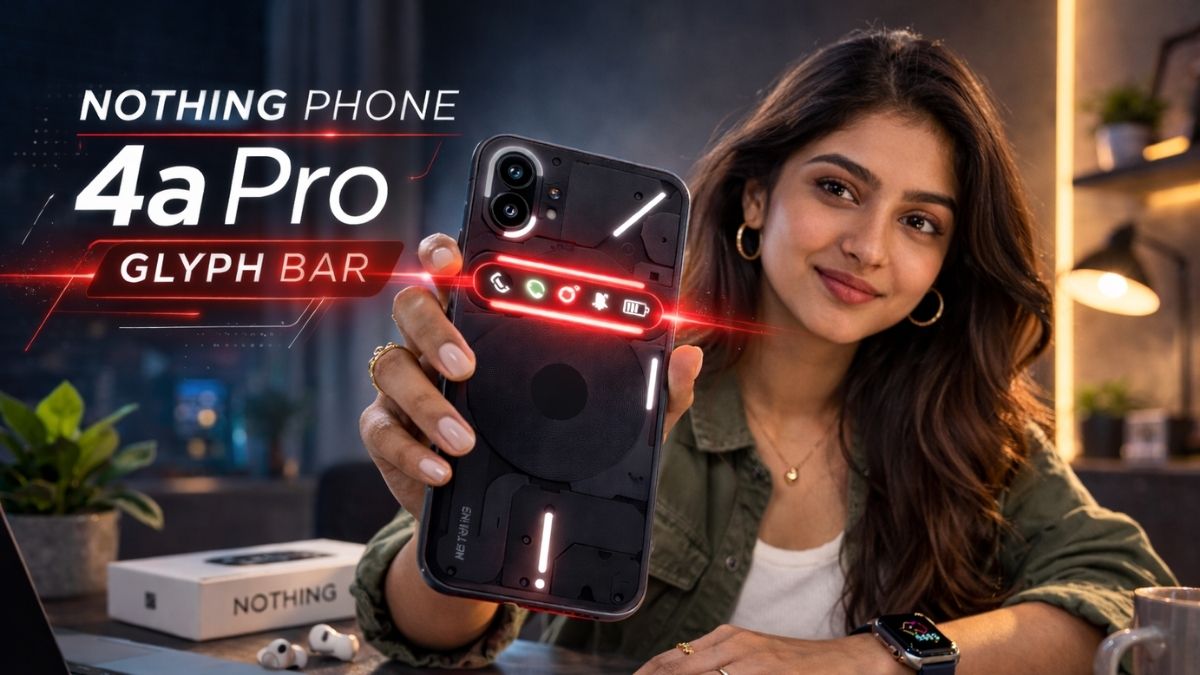
nothing phone 4a pro glyph bar arrives in 2026 as a design-first response to an industry drowning in sameness. At a time when most mid-range smartphones share identical glass backs, similar AMOLED panels, and near-copycat camera layouts, Nothing is attempting something far more strategic: turning hardware into a communication tool.
This isn’t just another spec-refresh cycle. The device introduces a redesigned Glyph Bar—a horizontal LED strip system that transforms notifications, charging updates, and app alerts into ambient visual cues. In simple terms, it lets you know what’s happening without unlocking your screen.
And in 2026, that matters more than ever.
Why the Mid-Range Smartphone Market Needed This
India remains one of the largest mid-range smartphone markets globally. Devices priced between ₹25,000 and ₹35,000 dominate sales volume. Yet differentiation has vanished. Most phones now offer:
120Hz AMOLED displays
50MP main cameras
Snapdragon 7-series processors
5000mAh batteries
Specs are no longer the deciding factor.
The Nothing Phone 4a Pro shifts the conversation from “How powerful?” to “How expressive?”
Nothing Phone 4a Pro Glyph Bar: What Exactly Is It?
The nothing phone 4a pro glyph bar replaces the segmented LED layout seen in earlier models with a more unified, horizontal lighting system. It’s expected to be brighter, smarter, and more context-aware.
Expected Functional Capabilities:
Visual call alerts without screen interaction
App-specific light patterns (messages, ride apps, deliveries)
Charging progress visualization
Camera timer & recording indicators
Third-party app integration via Nothing OS
This isn’t decorative lighting. It’s passive information delivery.
Quick Specs Snapshot (Expected)
| Category | Expected Details |
|---|---|
| Display | 6.7-inch AMOLED, 120Hz |
| Processor | Snapdragon 7s Gen-series |
| Rear Camera | 50MP main + improved tuning |
| Front Camera | 32MP |
| Battery | 5000mAh |
| Charging | 45W fast charging |
| OS | Nothing OS (Android 15-based) |
| Design Highlight | Glyph Bar LED system |
Final specifications may vary at launch.
Direct Answer: What Makes It Different?
The nothing phone 4a pro glyph bar stands out because it treats design as usability. Instead of relying solely on on-screen notifications, it allows users to receive alerts visually through hardware-based light signals. It reduces unnecessary screen checks and creates a distinct brand identity in a saturated market.
Performance: Is “Pro” Just Branding?
Not entirely.
While it won’t compete with flagship chipsets, expectations suggest:
Stable multitasking performance
Better thermal management than previous A-series models
Fluid UI optimized for Glyph interactions
For most Indian users—streaming, social media, light gaming, editing reels—that’s more than enough.
This is practical power, not benchmark bragging.
Camera Strategy: Smart, Not Loud
Nothing has historically focused on computational photography rather than megapixel wars.
Expected improvements include:
Refined HDR processing
Natural color calibration
Better night photography tuning
Enhanced video stabilization
For Instagram creators, YouTube Shorts users, and casual photographers, consistency matters more than sensor size.
Comparison: Design vs The Typical ₹30–35K Phone
| Feature | Nothing Phone 4a Pro | Typical Mid-Range Phone |
|---|---|---|
| Design Identity | Glyph Bar LED system | Generic glass slab |
| Notification Style | Hardware-based visual alerts | Screen-only |
| Software Experience | Minimal, clean UI | Heavy custom skins |
| Brand Recall | High visual differentiation | Low memorability |
| Upgrade Appeal | Emotion-driven | Spec-driven |
Nothing isn’t fighting on price alone. It’s building recall value.
Direct Answer: Who Should Buy It?
The nothing phone 4a pro glyph bar is ideal for:
Young professionals who value design
Content creators who want aesthetic hardware
Users upgrading from 2–3-year-old mid-range phones
Buyers tired of identical-looking smartphones
It’s not meant for hardcore gamers chasing maximum FPS. It’s built for expressive everyday users.
Software & Ecosystem Implications
Nothing OS is likely to deepen integration with the Glyph Bar through:
Customizable per-contact lighting
User-defined notification patterns
API access for developers
Sync with focus modes for digital well-being
If properly supported, this becomes a long-term ecosystem feature—not a launch gimmick.
Direct Answer: Is the Glyph Bar a Gimmick?
No—provided software support continues. The nothing phone 4a pro glyph bar becomes meaningful when it reduces screen dependency, improves clarity of alerts, and integrates seamlessly with apps. Without updates, it risks novelty. With proper execution, it becomes habit-forming.
Why This Matters in 2026
The global smartphone market has plateaued. Annual upgrades feel optional. Innovation fatigue is real.
If the Glyph Bar succeeds:
Competitors may revive hardware-level differentiation
Ambient interaction could return as a mainstream trend
Design may regain influence over buying decisions
In India especially, where mid-range dominates, this could reset expectations.
It’s not about brightness levels. It’s about behavioral change.
Future Impact: What Happens Next?
Looking ahead:
Expect Glyph Bar tech to scale across more models
Potential accessories syncing with Glyph signals
Deeper smart-home integrations
Focus on screen-time reduction features
We may be entering a post-screen-first interaction era.
Conclusion
The nothing phone 4a pro glyph bar doesn’t try to win the spec war. It aims to win attention—and possibly loyalty.
In a market where most phones blend into each other, Nothing is betting that expressive hardware still matters. If pricing is competitive and software support remains strong, this could become one of India’s most talked-about mid-range launches of 2026.
Sometimes innovation isn’t about adding more.
It’s about making what’s already there feel different.
Click to Find More: iQOO 15R Launch 2026: Price, Specs, and First Look Details
FAQs
When will it launch?
Expected in 2026, likely aligned with Nothing’s annual refresh cycle.
Will the Glyph Bar drain battery?
Optimized LED brightness and adaptive triggers should minimize battery impact.
Is it customizable?
Yes, per-app and per-contact customization is expected via Nothing OS.
Does it support third-party apps?
Future updates may enable open API integration for developers.
Is it good for gaming?
Suitable for casual and moderate gaming, not designed for extreme performance users.
Will it launch in India?
India is expected to be a primary launch market, alongside Europe and select global regions.